


Chapter 1: Competition Event Foundations
Lesson 1: A Day at a Competition Event

Learning Objectives
- Describe what a visitor would see and hear across a competition event day.
All VEX Robotics Competition events share a common shape. Regardless of the program, the same activities happen at all of them, in roughly the same order, for the same reasons. But no two events look identical, because every one of them is built and run by different people with different experience levels in a different place.
So before this course starts breaking the day into parts, here is one whole day, start to finish, as an example. The rest of this course will refer back to this fictional event as a shared context for talking about VEX Robotics Competition events and what happens at them.
- If you have never been to a competition, this is your picture of what you are signing up for — what an event might look like, sound like, and feel like from the inside.
- If you have hosted before, or spent seasons in the stands as a coach, read it and connect it to your own experiences. Some of it will look familiar. Some of it may be different from how you do things, and that is okay — it is useful information.
The event below is fictional, but ordinary: sixteen VEX IQ teams in a school gym on a Friday in November.
Tina's Tournament
Tina has coached VEX IQ at her middle school for three years, and every event her teams have attended has been somebody else's. There are four other schools with IQ teams within thirty minutes of hers, and every one of them travels to compete. She has access to a gym, and it sits empty on Fridays in November. So this year, her four teams and twelve other local teams are coming to her.
The morning of the event, teams arrive in waves. A school bus unloads eleven kids at 8:10 am, then nothing for ten minutes, then three cars at once. One team is stuck behind an accident on the highway and calls to say they're twenty minutes out. Tina tells them it's fine, and it is — she goes to tell the volunteer at inspection they will have some late arrivals at their station. Just inside the doors, two other volunteers greet coaches to check teams in and hand out pit assignments. A few steps away, that inspector sits with a checklist and a sizing tool while a sixth grader turns her robot over in her hands, showing him the parts he asks about. Her coach stands behind her with his hands in his pockets and says nothing, letting the student do the talking.
The pits for each team fill along the far wall — sixteen tables, team numbers taped to the front. By the middle of the morning every one of them looks lived in. Kits are open, spare pins sit in a cup, a line of batteries is charging on a power strip, a notebook is propped against somebody's water bottle, and there is a kid on the floor under a table chasing a part that rolled.
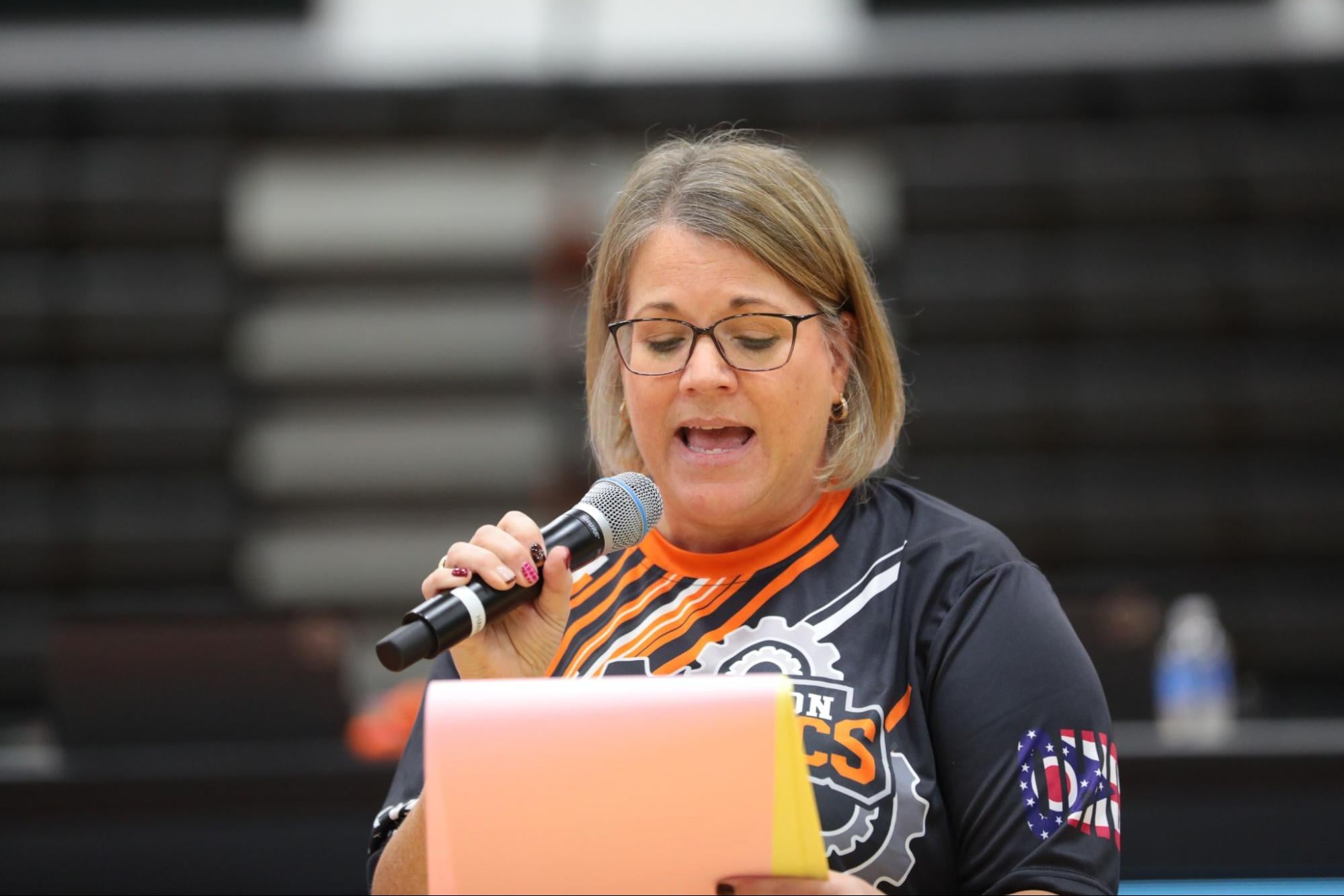
At 9:00 am, Tina and the Head Referee run the driver's meeting together. They talk to the teams about things like where to stand at the field, how to get a referee's attention, and to walk, not run in the gym. Then the Emcee calls for teams to queue for the first match, and the part of the day the kids are most excited about gets underway.
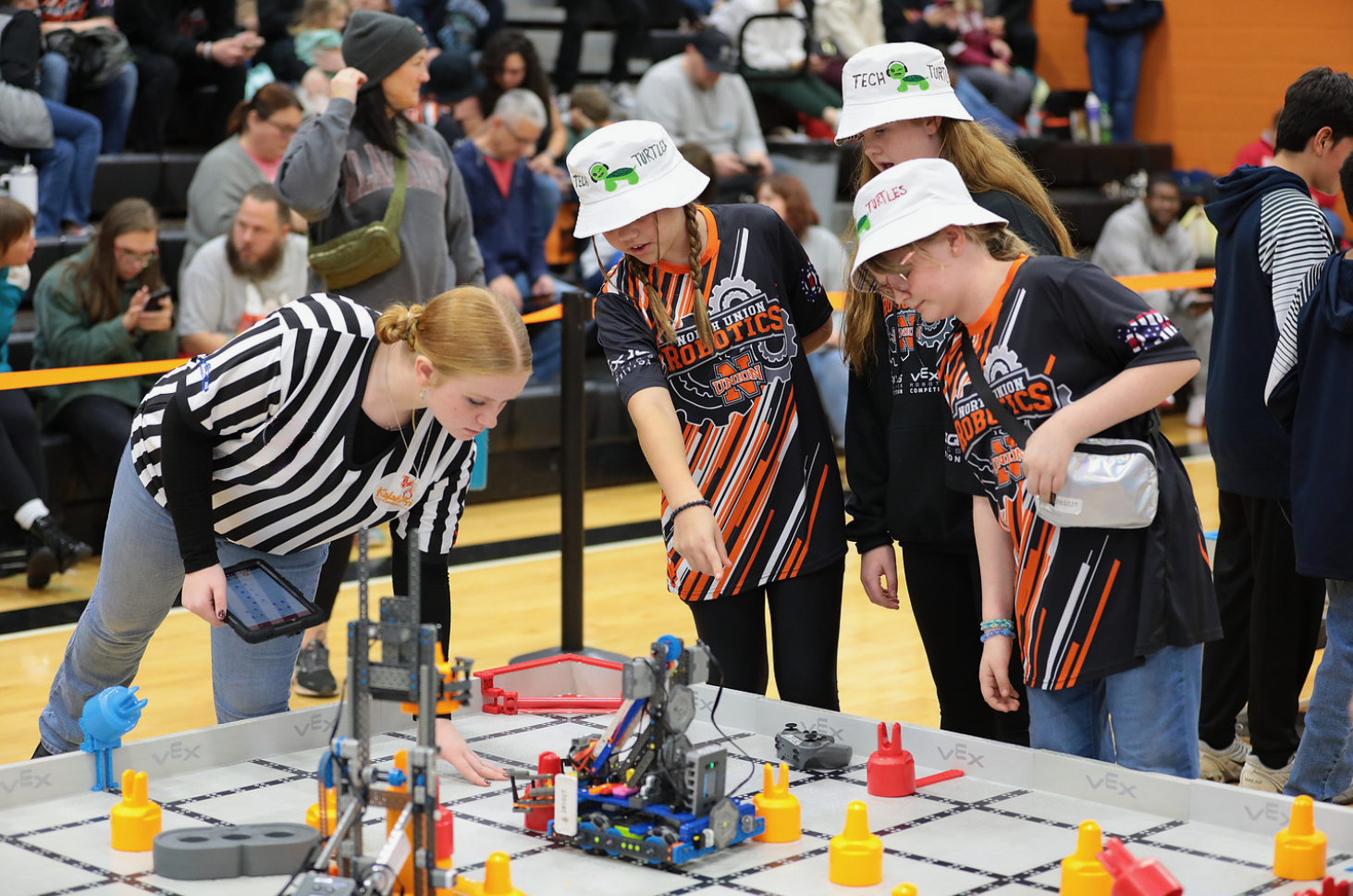
The two VEX IQ competition fields sit in the middle of the gym with the bleachers along one side, close enough together that spectators can easily watch both. At a table off to the side, a volunteer runs the tournament software, and screens on rolling carts show the schedule and the scores. The Emcee works both fields interchangeably and the Head Referee walks with her. When a match ends, the scorekeeper walks the field with a tablet, and the drivers stand beside the field and watch, so they are prepared when asked to confirm their score.
In one corner of the gym, a practice field holds teams meeting each other for the first time to figure out their strategy for their match. A high school volunteer makes sure nobody camps out for too long, while two teams crouch over the field working out who takes which side, one of them in their fourth season and the other team just six weeks old. Nobody has specifically told the older team to be patient. They are, mostly.
By mid-morning the whole room is going at once. Judges move through the pits with clipboards, crouching to table height so a conversation with a fourth grader happens at eye level, listening to a kid explain a mechanism that didn't work and what he tried instead. The Judge Advisor is setting up a classroom off the gym for judge deliberations later. Teams take turns at the Robot Skills field along one wall. In the bleachers, parents film matches on their phones, and a class of fifth graders who walked over from the elementary school screams at everything. Tina moves through all of it and rarely sits down — covering for volunteers so they can eat, walking a lost team to their pit, finding a chair for somebody's grandmother, and pointing what has to be the fortieth person toward the restrooms.
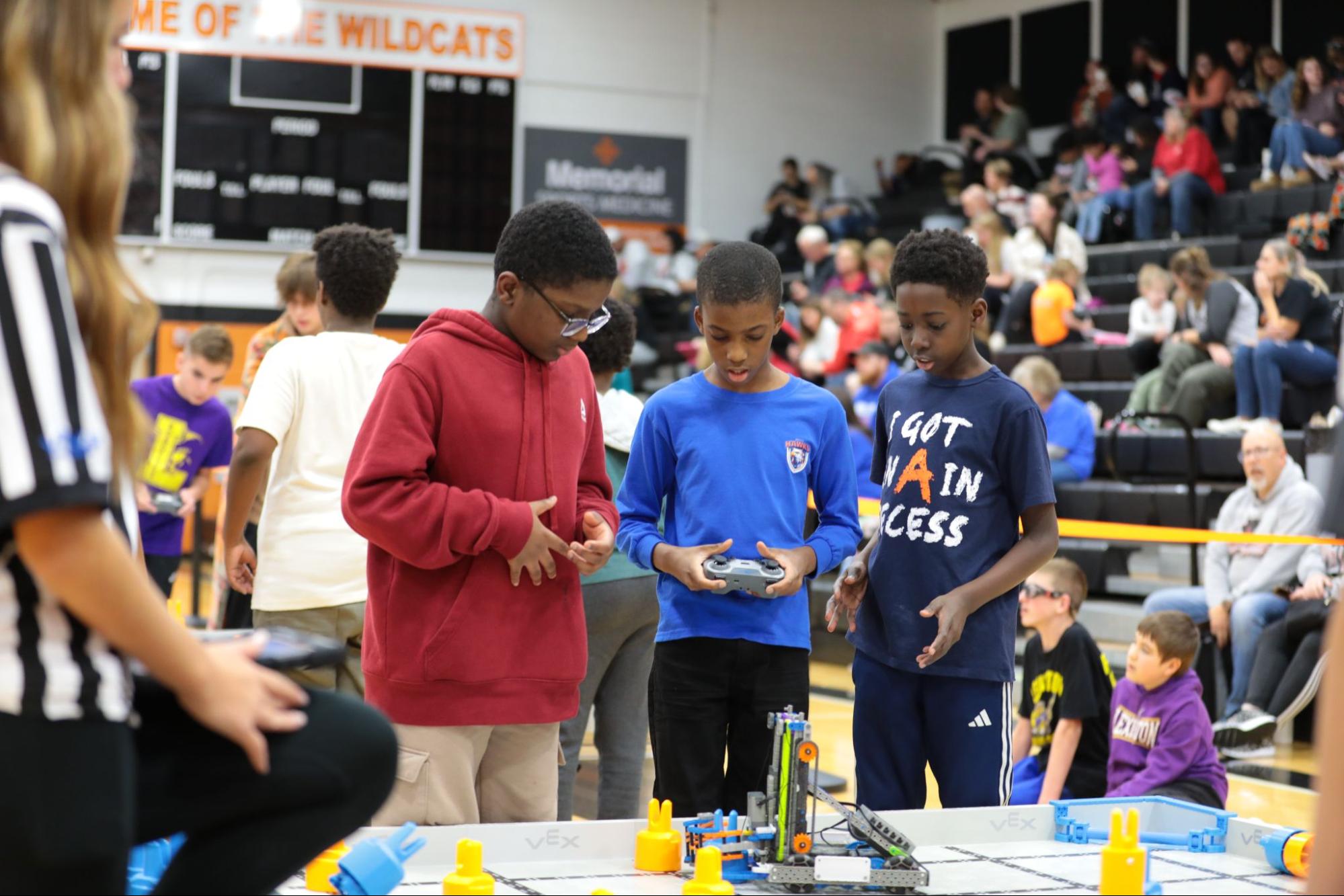
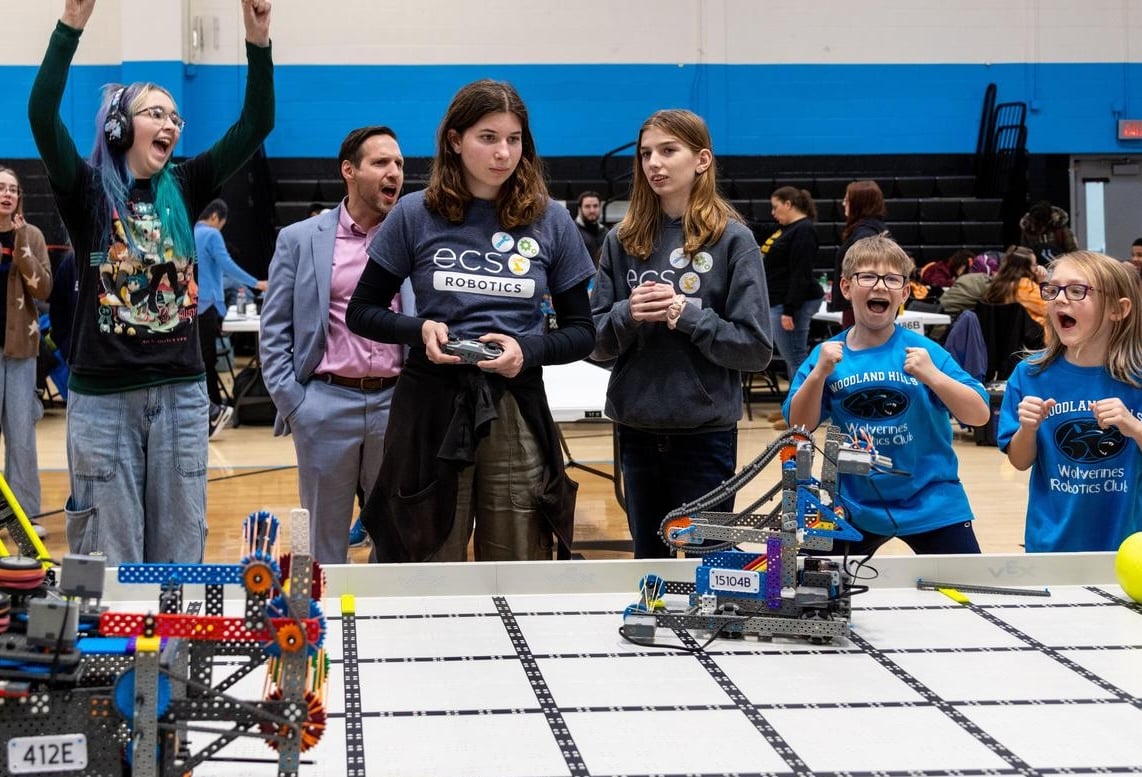
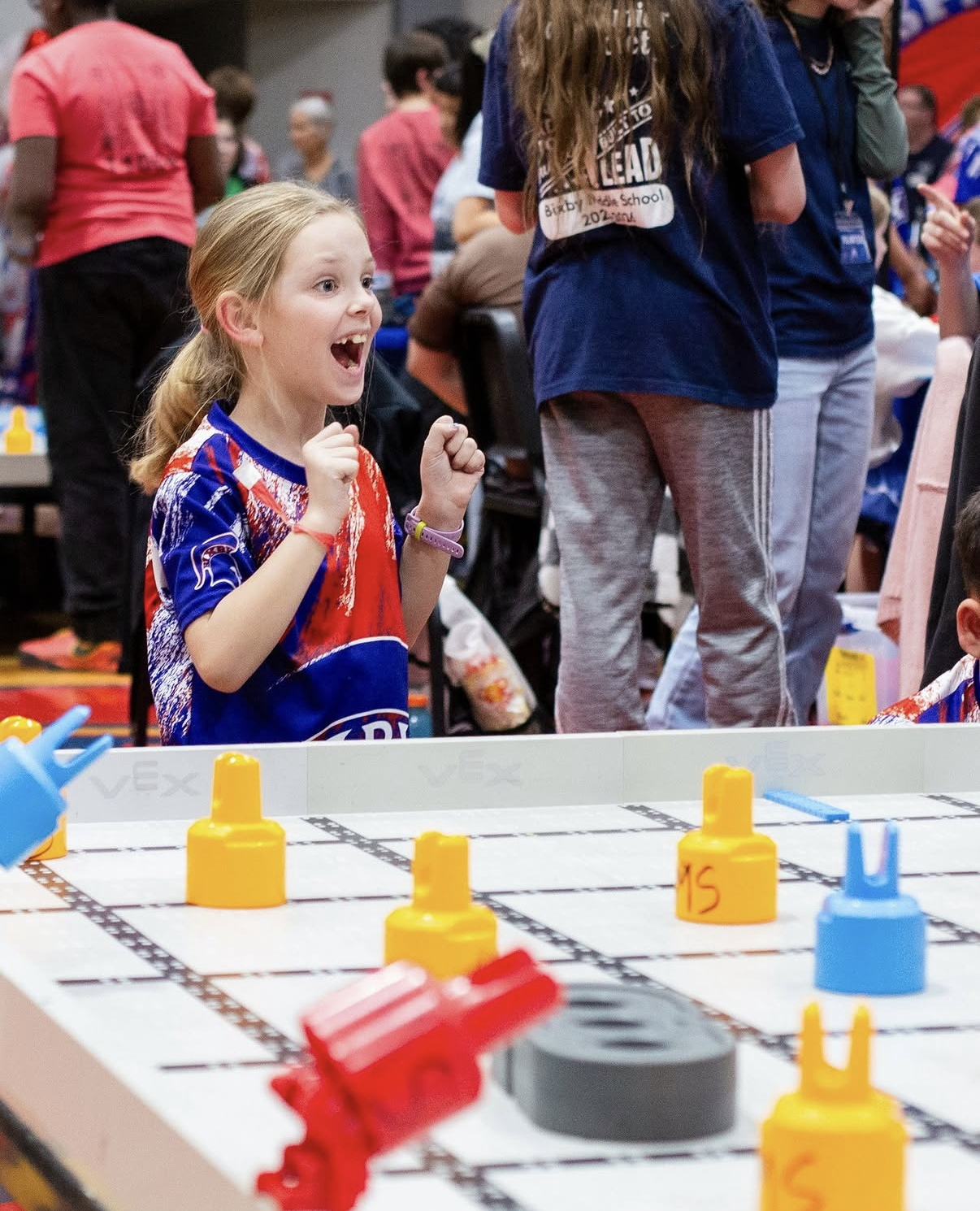
Qualification matches end at 1:00 pm, rankings post, and the room changes. Finals run slower on purpose, and everyone watches. A team that had a tough match in the morning scores big in front of the whole gym, and cannot stop celebrating.
Then it’s time for awards, and the gym is louder than it has been all day. The Emcee reads the names and Tina and the Head Referee hand out certificates. The teams called up are not only the ones who won matches — a team that finished thirteenth wins for their design, and a rookie team wins for how they treated everyone around them. Every one of them gets the same excitement from the bleachers. Kids come down the steps two at a time, cheering and posing for pictures with their award.
By 3:15 the tables are folded and the parking lot is emptying, and Tina is walking around the gym pulling tape off the floor. She never refereed a match, never ran a field, never touched the software. What she built was a room where a nine-year-old could explain her own robot to a stranger, where a team that lost every match still had a good day, and where the loudest cheer went to a kid who never once stood at the field. That was the job, and she's so glad she did it.
Nothing on that day happened by itself.
The volunteers knew where to be because somebody recruited them and told them what to expect. The schedule held because somebody built it to fit the hours the gym was available. Inspection stayed open for a late team because somebody had the authority to make that call and enough slack in the morning to afford it. Teams found their pits because the tables were numbered the night before.
That is the shape of this work. Almost everything an Event Partner does is finished before the doors open, and the day itself is mostly about protecting what was already decided.
It is also worth noticing what the day was for. Sixteen teams came and a few of them won. The others drove home from an event they did not win, already excitedly looking ahead to the next one. They got matches in, learned from teams they had never met before, and found out their robot could do more than it could do last month. A good event is worth the trip for every team in the room, not just the ones holding an award, and building that is your job.
Everything in that gym also rested on a shared set of expectations that nobody in the room had to say out loud. The next lesson makes them explicit.