


Chapter 4: Planning Your Event
Lesson 1: Choosing a Date, Venue, and Budget

Learning Objectives
- Explain how an event's date, venue, and budget choices shape what the event could be.
- Explain how changing an event’s date, venue, and/or budget impacts one another.
- Identify the questions to ask when evaluating a specific date, venue, or budget.
Three decisions come before all the others: when your event happens, where it happens, and what it costs. This lesson works through all three and how they impact an event, using the following example:
- Who: Twenty VEX IQ teams
- What: VEX IQ Robotics Competition Qualifying Event
- When: A Friday during the school day
- Where: In a school gym
- How: Two competition fields, one Robot Skills field, and one practice field. No judged awards.
Getting to this event structure took three main decisions, each one impacting the next.
Start with the Where
Most first events start with the where, because a venue can be the hardest thing to get and the easiest thing to lose. The example event started with a school that had a gym available and a teacher (Event Partner) willing to host.
A gym floor is a fixed size, and everything the event needs has to fit on it: the competition fields, a Robot Skills field, a practice field, a pit table for every team with room to work around it, check-in and inspection near the door, and somewhere for spectators to watch.
In this instance, four fields fit. A fifth does not, and that is what eventually sets the team count at twenty. Lesson 3 will help guide you through that calculation.
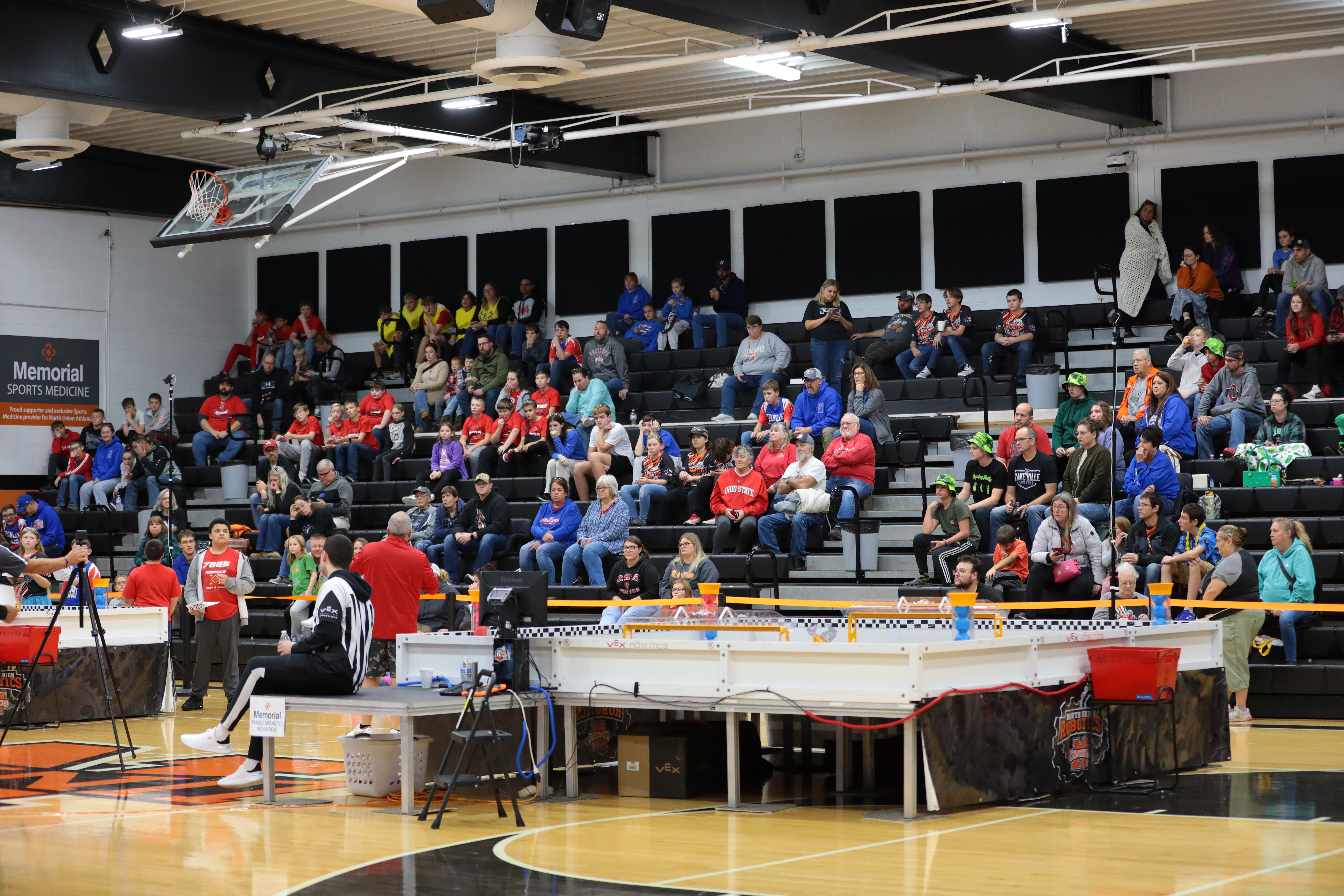
Whatever room or venue you choose has to be safe, secure, and accessible to everyone attending, and it has to meet whatever insurance requirements apply. Beyond that, ask:
- When can you get in to set up, and can you get in the night before?
- When do you need to be cleared out of the space?
- Is there power that you can get for the fields, the head table, and the pits, and a reliable local network for tournament software?
- Where do people park, and how do you load in?
- What insurance and paperwork does the venue require?
- Who handles custodial support before, during, and after?
Read Planning Your Venue and Event Space for how to lay out the space once you have it.
Then the When
A gym inside a school points at a school day, and a school day suits many VEX IQ events. These teams are younger, they usually travel with their school, and a school-hours event asks nothing of families' evenings or weekends.
It also hands you a hard deadline. Buses need to be prepared for school dismissal, which means every team traveling by bus has to be loaded and gone before then. Awards finish before that, and everything else on the schedule gets planned backward from it.
Here is what moves if you hold everything else and change only the day of the week. Note that these are generalized statements. There will always be outliers with any event, but it is good to remember what the general outcome may look like.
| Event Details | Weekday | Weekend Day |
| How Teams Arrive | With their school, on school buses | Families or coaches drive |
| When the Event Ends | Set by bus and dismissal schedules | You may have more control over the end time |
| Who Volunteers | Teachers, staff, and older students on site | Parents are more available; school staff largely are not |
| Venue Cost | A school space is often free for staff | Rental or custodial overtime is common |
Neither column produces a “better” event. What differs is what each one asks of the Event Partner planning the event.
Two things narrow a date further. Season timing matters: early-season events are lower pressure and draw simpler robots, late-season events fill faster because teams want a last qualifying opportunity, and mid-season sits between the two. And a date needs space in front of it — registration has to open well before event day, and your certified volunteers have to be posted before that, so a date just a couple weeks out is usually not a date you can use.
Read Picking a Date for Your Event for the full set of considerations and the current season's deadlines.
Then the Budget
Once you have a venue and date, much of the budget has been decided for you. A free gym and twenty teams means registration only has to cover fields and game elements, awards, printing and consumables, and food for your volunteers. However, if you are renting a space, venue and facility costs are likely going to be the largest portion of your budget.
Read Budgeting for Your Event for the full cost breakdown and fee-setting guidance. The Event Partner Budget Planner is a Google Sheet that you can use to plan and track your event’s budget. Make your own copy before you begin, then fill in your expected costs and income as you plan. The totals calculate automatically, and the template shows your projected profit or loss both as a whole and per team, which is vital in helping determine your registration fee.
It is important to note that team count and registration fee move together. Most of what you are paying for — the fields, the awards, the printing, the venue — costs about the same whether sixteen teams come or twenty-four, so every team you add lowers what each one has to pay. A lower fee is easier for a school or a parent group to say yes to, and that tends to bring more teams. The give and take is that more teams also need more pit space and more time, which sends you back to the room and the date.
Set your registration fee from your budget total. Add up your costs, divide by the number of teams you expect, and compare the result against what other events in your region charge. Then decide deliberately whether you are trying to break even or raise funds, and adjust accordingly.
Making Decisions with Your Program Support Team
A Saturday event in a rented hall for thirty-six teams is a good event. So is a twenty-team event on a Friday in a free gym. Your Program Support Team knows the regional calendar, what other events are being planned near you, and what teams in your area have paid for event registration.

Together, Event Partners and their Program Support Team can determine what levers to pull while planning an event. Your decisions benefit from someone who can see past your event. Bring your candidate dates, your budget and fee, and anything that will cost an attendee money to your conversation, and talk it through until you have reached a decision that works for everyone involved.