


Chapter 2: Match Play at a Qualifying Event
Lesson 2: Match Play at a VEX V5 Competition Event

Learning Objectives
- Explain the purpose of Qualification Matches at a VEX V5 event.
- Identify the minimum team count and minimum matches per team required for a qualifying V5 event.
- Identify the personnel and materials required to run one V5 competition field.
- Describe how Qualification Match rankings determine Alliance Selection order at a VEX V5 event.
- Describe how Alliance Selection runs and what the Event Partner provides for it.
- Explain how Elimination Matches work as a bracket, with Alliances advancing or being eliminated until one remains.
- Identify that the Tournament Champion awards are determined by Elimination Match results at a VEX V5 event.
A VEX V5 Robotics Competition event day has three acts. Qualification Matches fill most of the hours and produce a ranking. Alliance Selection turns that ranking into the Alliances that play for the title. Elimination Matches close the day and decide the event's Tournament Champions.
Qualification Matches
Every match on the competition field is a Head-to-Head Match. Two Alliances, one red and one blue, each made up of two teams, compete to outscore each other. A match runs two minutes: a fifteen-second Autonomous Period, when robots run pre-programmed code with no driver input, followed by a minute and forty-five seconds of the Driver Controlled Period.
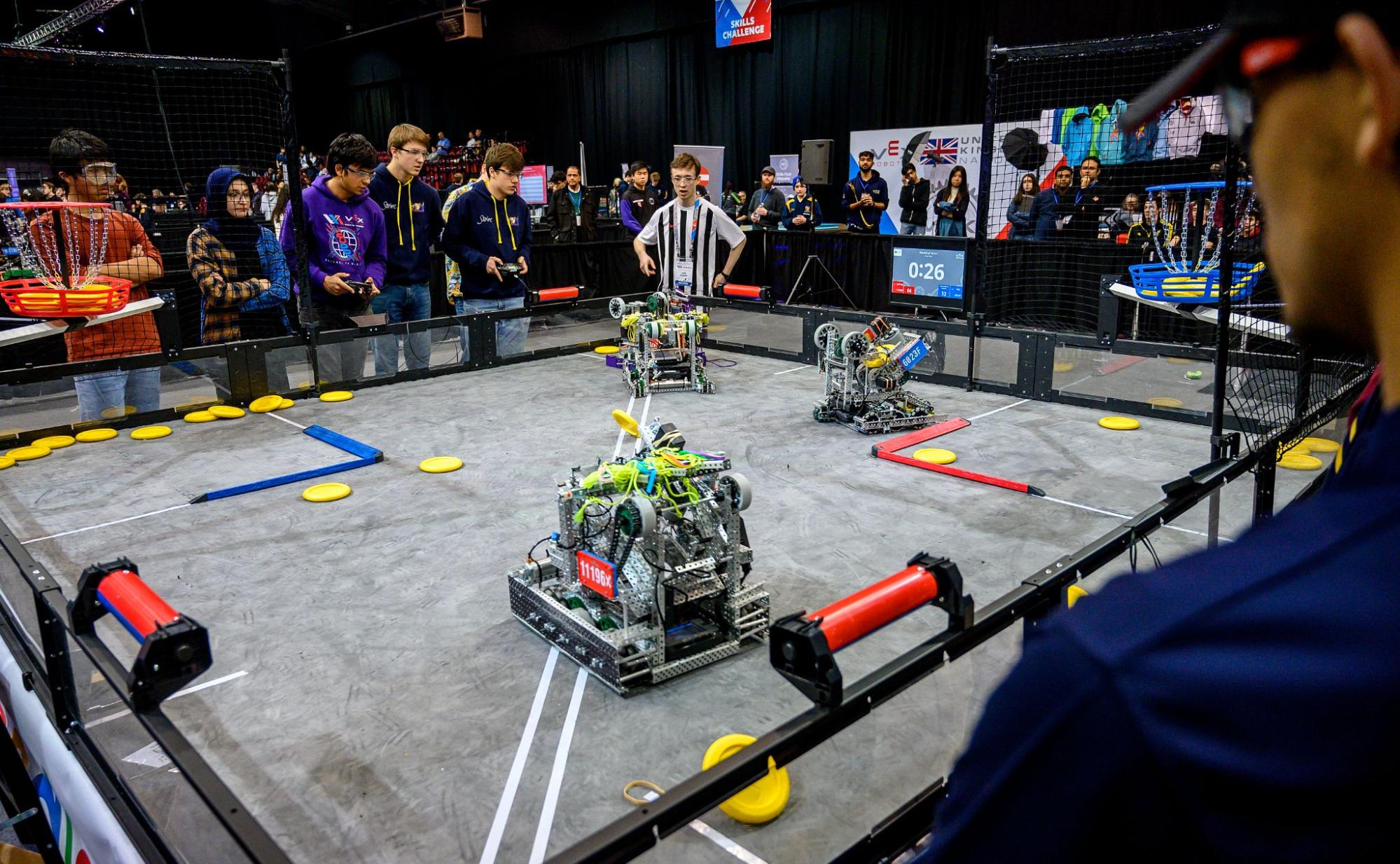
Qualification Matches are the Head-to-Head Matches that produce rankings. Every team plays a guaranteed number of Qualification Matches, and nobody is eliminated along the way. A team that loses its first three matches plays the rest anyway. They came for a day of robotics and testing their skills, not for three matches.
Nobody picks the pairings for an Alliance, including the Event Partner. The event software randomizes them, so a team plays alongside several different partners across the day and meets most of them that morning. That is part of the challenge, and it is why your venue fills up with pairs of students crouched over a notebook between matches, working out who is doing what.
Up to three students from each team go to the field and their Alliance Station for the match, where they drive the robot and introduce Match Loads into play. Adults are not permitted at the field during a match.
What a Qualifying Event Requires
While the words qualification and qualifying get used in the same breath all season, they mean different things. A Qualification Match is a single match a team plays. A qualifying event is the kind of event you're hosting — one approved to advance teams to the next level. Running enough Qualification Matches is part of what makes an event a qualifying event.
Two of the qualifying event requirements you met in Chapter 1 directly impact Qualification Matches:
- At least 16 registered teams.
- At least 6 Qualification Matches per team.
Those two numbers set the size of your day. Sixteen teams playing six matches each is 96 team appearances, and with four teams on the field at a time, that's 24 matches. Chapter 4 will cover more about how the number of teams and number of fields impact your schedule.
The Flow of a Match
The clearest way to see what a field needs is to watch one match go by.
Before the match starts, a Field Resetter has returned every scoring object to its starting position and confirmed the field is ready. The Queuer has walked this match's four teams over from the pits and has the next teams waiting nearby. Drive Team Members place their robots and take their positions in the Alliance Stations, plug their controllers into the field using the Field Control System, and the Emcee introduces the teams to the room.
Then the match runs. Field control starts it, triggering any code the students wrote for the Autonomous Period, pausing to determine Autonomous scoring, restarting for the Driver Controlled Period, and disabling all controllers when time expires. Throughout, the Head Referee watches for rule violations while a Scorekeeper Referee watches what's being scored.
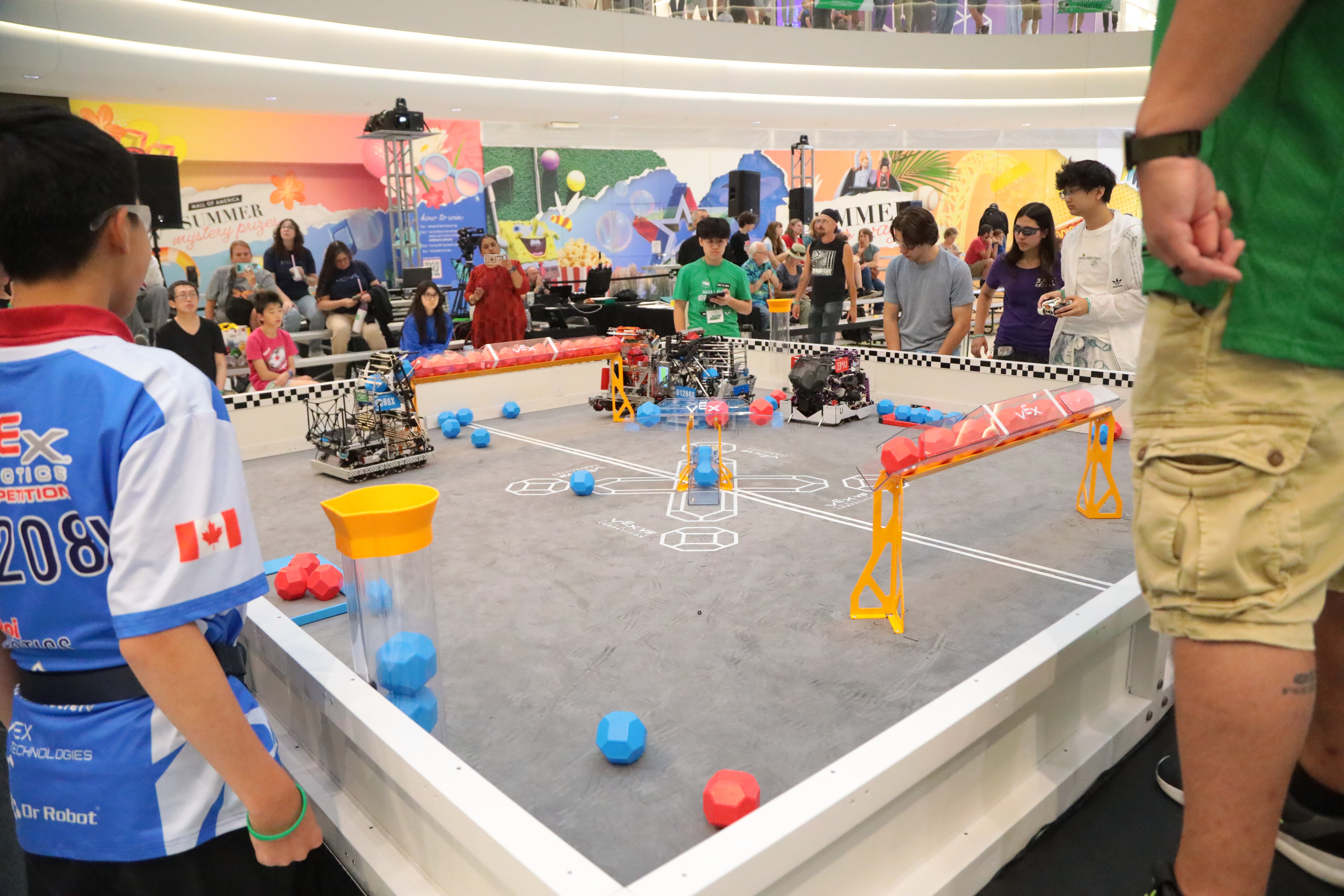
When time expires, the referees read the field and score the match. The score isn't official until it has been confirmed with the teams. Students who have a question about the score, or who want a ruling explained, stay in their Alliance Station until the Head Referee has talked with them. That conversation belongs to the Head Referee: no other volunteer explains a ruling, and it's the students who ask, not their coaches. The Head Referee's decision is final. Once the score is settled, the Emcee announces the result and the Field Resetter is already resetting for the next match.
Each VEX V5 Robotics Competition field needs:
- The volunteer roles listed above, including a Head Referee, Scorekeeper Referee, Field Resetter, Emcee, and Queuer
- You will learn more about volunteer roles and planning in a later chapter.
- A competition field, built to the current game's specifications.
- A Field Control System connected to the official event software.
- A display showing the match timer, the teams playing, and the score.
Field control is the hardware that starts and stops the match, enabling and disabling the robots on the timer. It's why teams plug their controllers into the field before every match. You need one at each competition field, but you won't be running it — it connects to the official event software, and the volunteer operating that software drives it from there. You can learn more about setting up field control in this section of the library.
Keeping Fields Moving
Queuing can be easy to underestimate. Teams are spread across the event at their pits, the practice field, and the Robot Skills line, and they may not appear at the field on their own. With four teams in every match, a queuer is moving twice as many people as at a VEX IQ event, and a single team that isn't ready can hold up three others. A queuer working two matches ahead absorbs the ordinary delays, like a team fixing a robot or a team that didn't hear the announcement, before those delays reach the schedule.
Moving from Qualification Matches to Elimination Matches
Once every Qualification Match score has been entered, the event software can produce a ranked list. Rankings are calculated by the software based on the rules in the Game Manual, not by you or anyone else at the event.
That ranking has one job: it sets the order for Alliance Selection.
Alliance Selection
Alliance Selection is where teams choose the partners they'll play the elimination bracket with. It happens after Qualification Matches end and before Elimination Matches begin, and it is its own block on your schedule.
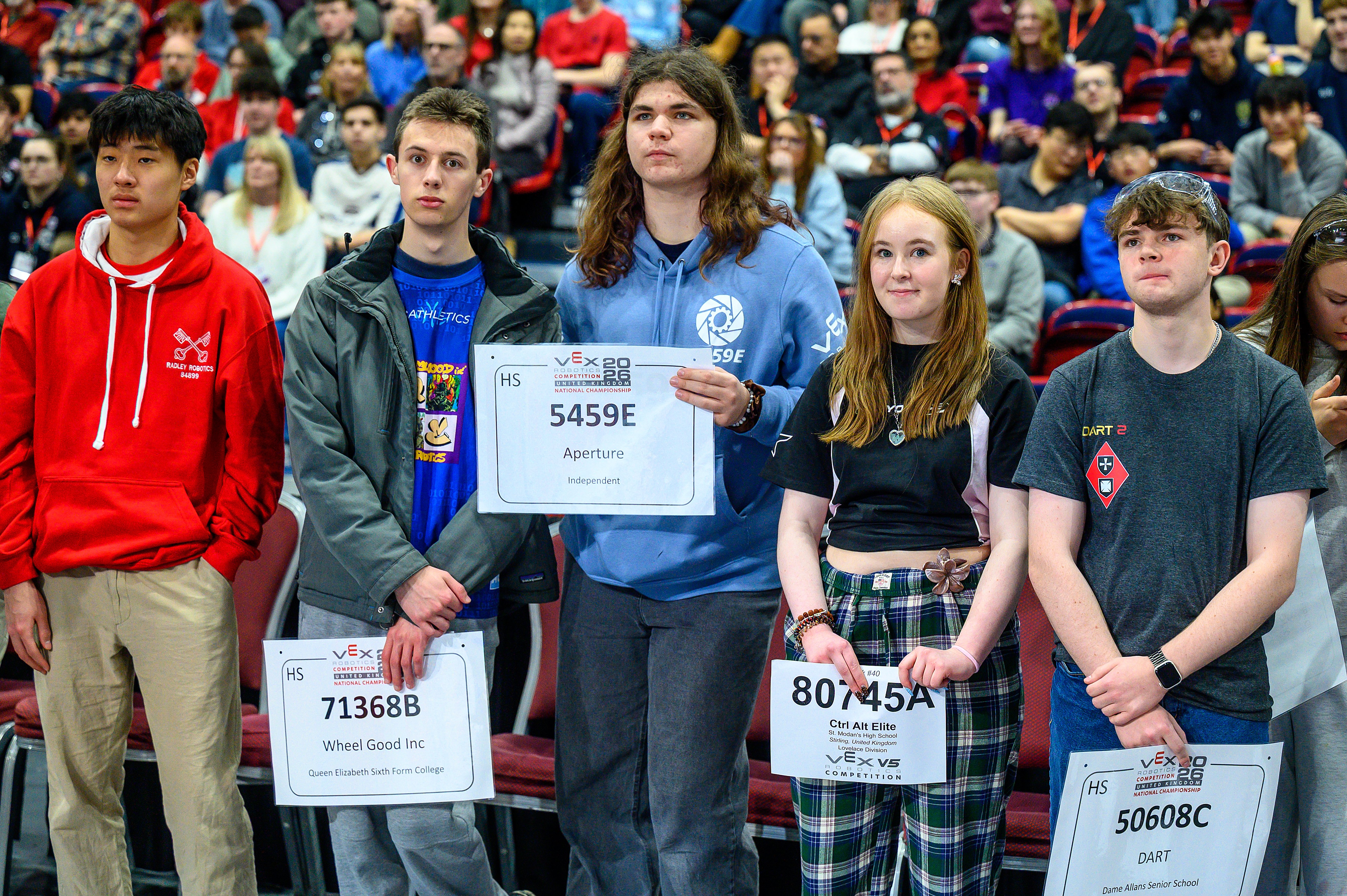
The shape of it is simple. The top-ranked team becomes the first Alliance Captain and invites another team to join them. That team accepts or declines. The next-highest available team becomes the next captain, and so on until every Alliance is formed.
Watch this video to learn more about the Alliance Selection process.
How many Alliances you'll have depends on your team count. An event with 16 to 23 teams forms 8 Alliances. At exactly 16 teams, that means every team at your event ends up in an Alliance for Elimination Matches.
As an Event Partner, you provide the time and space for Alliance Selection to occur. Often the Head Referee or Emcee will facilitate the process. Teams need somewhere to gather where the student representatives from each team can be seen and heard, and enough time that the selection process isn't rushed. Every team sends one representative, who may bring written notes and scouting lists. No electronic communication is allowed once selection begins.
This is one of the most visibly student-centered parts of your day. The students make the picks, and coaches watch. Brief your volunteers to expect that and to keep adults from coaching from the sidelines.
Elimination Matches
Elimination Matches are a tournament bracket, and that makes them different from everything that came before. In qualification, every team plays every scheduled match. Here, Alliances advance or are eliminated. The bracket narrows from eight Alliances to four, then to two, then to one winning Alliance.
One thing that differs between Qualification and Elimination Matches is time-outs. Each Alliance in the bracket gets one three-minute time-out, which they can call between matches to repair a robot. This may impact your schedule as an Alliance that uses one adds three minutes plus the setup around it. More about determining your schedule will be covered in Chapter 4.
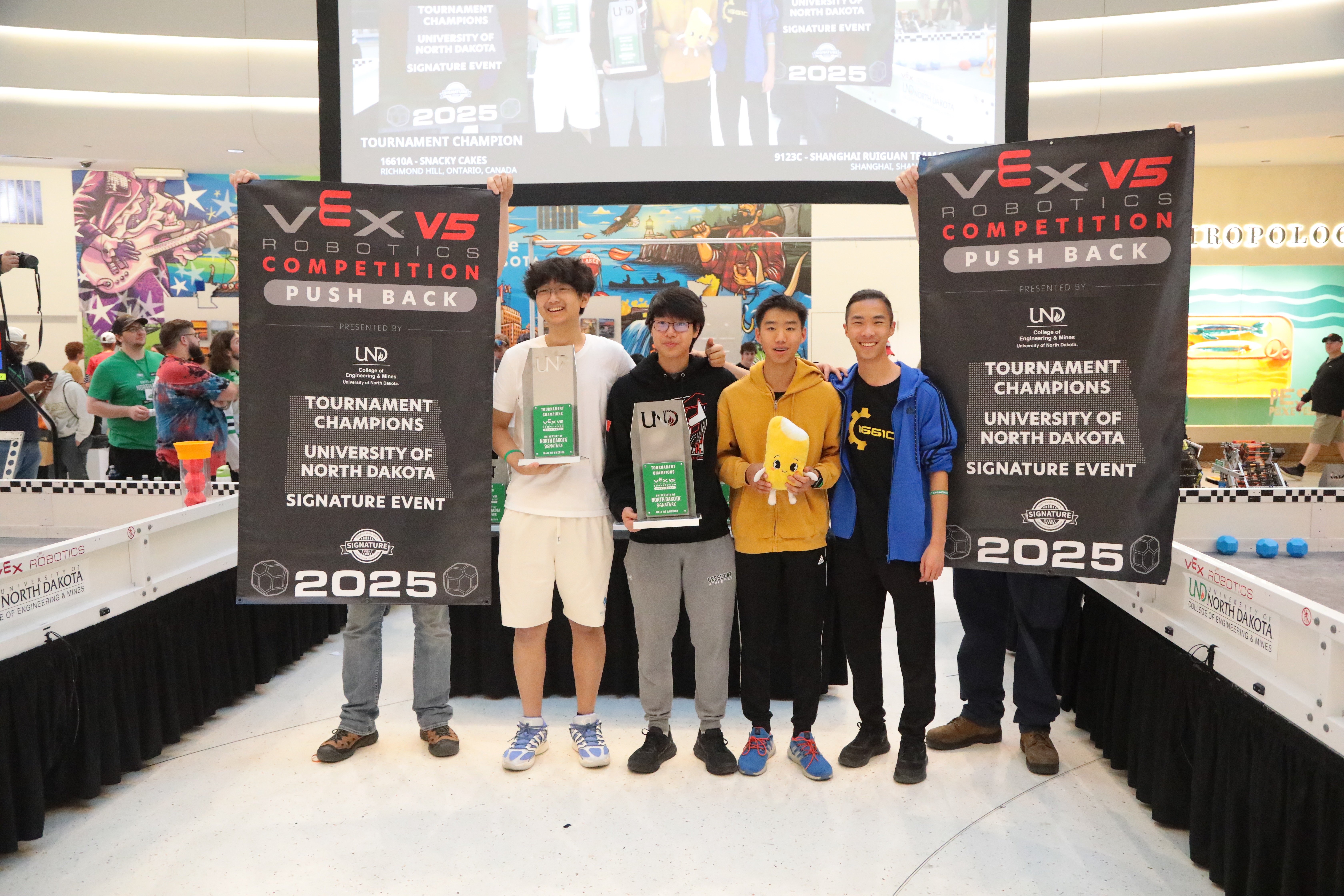
The two teams in the Alliance that wins the final match are the event's Tournament Champions. Both teams share the award. It's a performance award, so winning it has no bearing on either team's eligibility for a judged award, and it's one of the awards that can carry a qualifying spot to the next level, as covered in Chapter 1.
The Rules Behind This Lesson
Everything in this lesson comes from the Event Qualifying Criteria and the VEX V5 Robotics Competition Override Game Manual in Section 5, The Event. You do not need to memorize the rules, but you should know they exist and where to find them when a question comes up on event day.
Review Rules <T1> through <T19> in the Game Manual to see how they connect to what you just learned about match play before moving on to the next lesson.