


Chapter 2: Match Play at a Qualifying Event
Lesson 3: The Robot Skills Challenge

Learning Objectives
- Identify that all teams must have the opportunity to compete in Robot Skills Matches in parallel with Qualification Matches.
- Distinguish between Driving Skills and Autonomous Coding Skills Matches.
- Identify that teams can attempt a maximum of three Driving Skills and three
- Autonomous Coding Skills Matches at an event.
- Identify the personnel and materials required to run a Robot Skills field.
- Explain how Robot Skills scores support rankings and advancement.
- Identify that Robot Skills Matches can be hosted as a standalone Robot Skills-Only event.
Qualification Matches and the matches that follow them (Finals or Eliminations) are the parts of the day that appear on a schedule. The Robot Skills Challenge is the part that does not, and that is what makes it easy to underestimate. There is no skills schedule to build and no bracket to post. There is a field along a wall that opens when the doors open and keeps running all day while everything else happens.
It is worth being precise about how Robot Skills Matches relate to an event. Offering the Robot Skills Challenge is required of the Event Partner. Attempting it is optional for a team. Plenty of teams will skip it, and plenty more will take two runs and forget the rest. Your obligation is not that teams participate. It is that the opportunity is genuinely there.
Before continuing, read the following Robot Skills-related rules from the Tournament Rules section of the current game manual for the program you are running events for:
- VEX IQ Level Up Game Manual
- <T7> and <T16> Field modifications and consistency
- <T15> Skills Match Schedule
- <T17> and <T18> Skills Rankings
- VEX V5 Override Game Manual
- <T7> and <T21> Field consistency
- <T20> Skills Match Schedule
- <T8> and <T9> Field control and field perimeter types
- <T22> and <T23> Skills Rankings
Two Kinds of Robot Skills Matches
A Robot Skills Match is a Driving Skills Match or an Autonomous Coding Skills Match. Both are one minute long, both are played by a single team with a single robot, and neither has an opponent on the field.
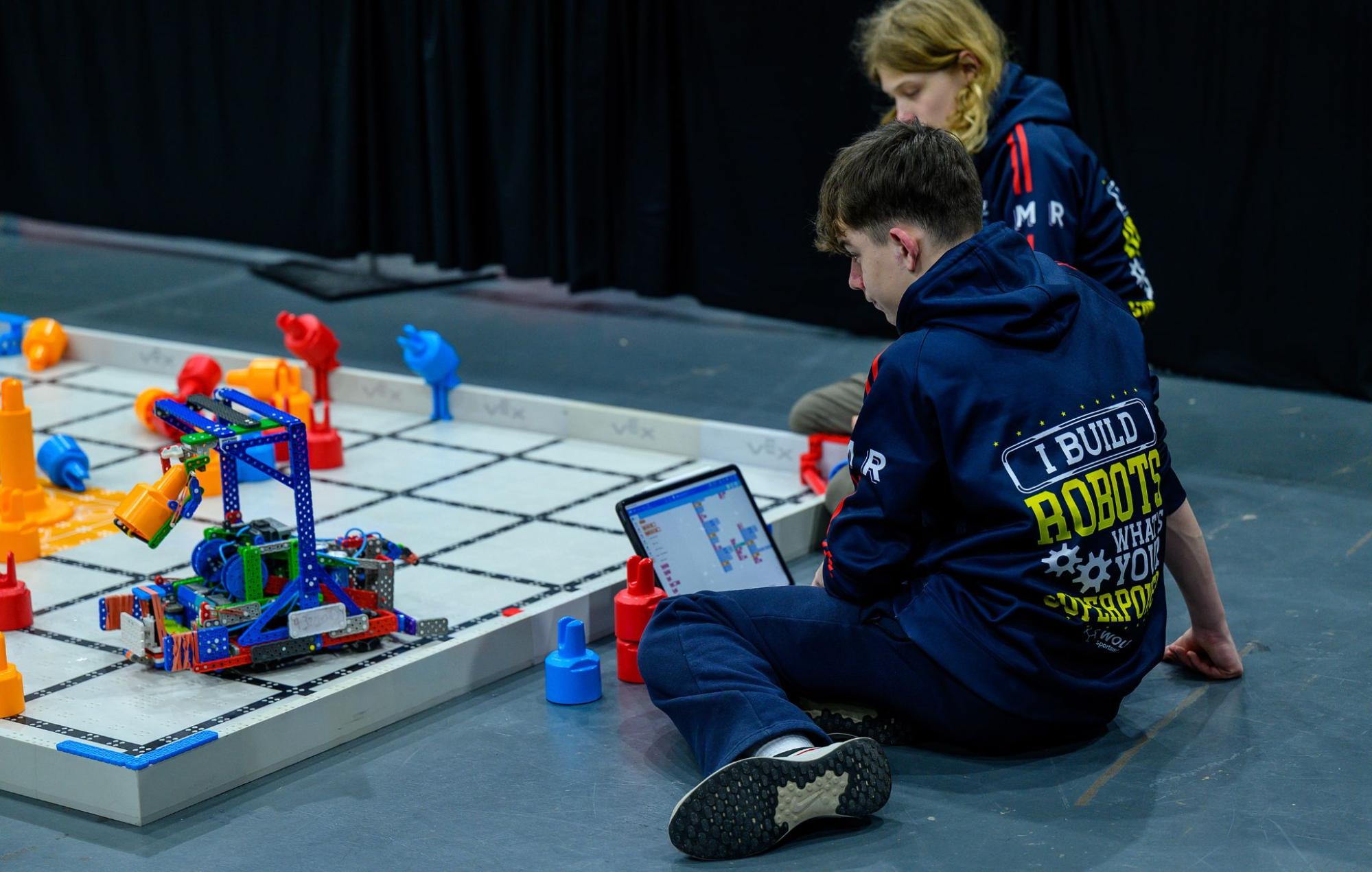
- Driving Skills Match: One team operates their robot during a one-minute Driver Controlled Period. There is no Autonomous Period.
- Autonomous Coding Skills Match: A single robot operates during a one-minute Autonomous Period. There is no Driver Controlled Period.
Teams can elect to end either kind of match early if they wish to record a Skills Stop Time.
Both kinds of matches run on the same field under the same scoring rules as set by the Robot Skills section of the Game Manual. A team's Robot Skills score is its highest Driving Skills Match score plus its highest Autonomous Coding Skills Match score. It is not an average, and not a total of everything attempted. A team with one strong match and two rough ones is in good shape.
Each team may attempt up to three matches of each kind, six matches in all, and you cannot offer more. Matches are first come, first served. Teams walk over between their Qualification Matches and take the next open slot, so there is nothing here for you to schedule. Your responsibility is to ensure that your schedule gives teams the breathing room to go attempt these matches.
What You Must Offer
Chapter 1 listed Robot Skills among the qualifying criteria. Spelled out, the Event Qualifying Criteria article asks three things of you, plus one piece of follow-up:
- Give every team the opportunity to complete up to three Driving Skills and three Autonomous Coding Skills attempts.
- Schedule Robot Skills so that teams have a reasonable opportunity to complete those attempts.
- Close the Robot Skills Challenge no later than the conclusion of Qualification Matches.
- Upload Robot Skills scores with your official event results.
The burden on an Event Partner is that all teams have the opportunity to complete their six Robot Skills Matches. It is recommended that you open the Robot Skills field as soon as the Driver’s Meeting has concluded and be sure it stays open for the entire qualification period. With six matches per team, a queue at one field, and a day that has to end on time — there is not necessarily a block later in the day large enough to hold the Robot Skills Challenge. That is why it runs in parallel rather than in a slot of its own.
If every team has taken all six attempts before Qualification Matches are concluded, you are welcome to close that field early. More about these timing considerations will be covered in Chapter 4.
Running a Skills Field
A Robot Skills field is the lightest field at your event to staff (besides practice fields), which is what makes running one alongside your competition fields realistic, even for a first event.
You need a trained Scorekeeper Referee at the field the whole time matches are running. A second Robot Skills field means a second Scorekeeper Referee. Learn more about different referee types in this article.
The materials are simple:
- A competition field with its field elements, set up to the manual's specifications.
- Note that the Robot Skills setup often differs from the standard Qualification Match setup.
- A scoring device connected to your tournament software or paper scoresheets, so matches are recorded as they happen.
- A match timer that teams and volunteers can see.
At a VEX V5 event, your Robot Skills fields also need a Field Control System, and every Robot Skills field at the event has to use the same type of Field Control and field perimeter (rule <T21>).
The Robot Skills field itself does not have to match modifications made to your competition fields. If those competition fields are elevated, your Robot Skills field does not have to be. What is required is that your Robot Skills fields be consistent with each other, if you run more than one.
Where Robot Skills Scores Go
Robot Skills produces its own ranking at your event, separate from qualification standings and built from each team's combined score. Your tournament software applies the manual's tiebreakers. None of it is arithmetic you have to do by hand. The team with the highest combined Robot Skills ranking at the event is awarded the Robot Skills Champion award.
These rankings apply to your event as well as in a larger competition context. When you upload your results, those scores join the World Skills Standings on events.vex.com, and Championship Events may use the standings to fill open spots when additional invitations are available. Skills-based advancement is never guaranteed, and the ranking list used varies by program, region, and season.
Robot Skills-Only Events
Robot Skills can also exist beyond a local qualifying event. A Robot Skills-Only Event is an official qualifying event that offers only Robot Skills Matches. Teams post official scores that feed the World Skills Standings exactly as they would at a tournament. It counts as a qualifying event, but it hands out no direct qualification spots — teams advance on their scores instead. The Types of VEX Robotics Competition Events article describes Robot Skills-Only events alongside the other event types.
The day is a much smaller one to run: Robot Skills fields, Scorekeeper Referees, a Head Referee available, and none of the match schedule or ranking mechanics the rest of this chapter describes. That makes it a good option for a first event, and a common one late in the season when teams are chasing standings before championship deadlines.
Did you know?
Registered teams can also practice and compete in Robot Skills Matches using Virtual Skills. Virtual Skills allows teams to code and drive virtual versions of this year’s Hero Bot in Driving Skills and Autonomous Coding Skills Matches. Scores in VEXcode VR submitted by registered teams go into the global Virtual Skills Standings leaderboard: VEX IQ Virtual Skills Standings, VEX V5 Virtual Skills Standings.

In addition, teams can earn a spot at the VEX Robotics World Championships by entering into the VEXcode VR Autonomous Skills Global STEM Challenge.