


Chapter 6: Robot Interaction and Judgment Calls
Lesson 1: Expansion, Boundaries, and Field Conduct

Learning Objectives:
- Apply the horizontal and vertical expansion rules during a match.
- Distinguish accidental from intentional field or robot damage and the typical violation level.
- Describe when an interaction or action requires Head Referee judgment, and when the benefit of the doubt applies.
A robot that starts a match within its size limits does not stay frozen at that size. It reaches, lifts, and extends as it plays, and it shares the field with a partner robot doing the same. Most of what happens as a result is expected and legal. This lesson covers the boundaries a robot must stay inside, and how you tell a routine part of gameplay from something that needs a ruling.
Before continuing, read the following rules in the current Game Manual:
- <SG2> Horizontal expansion is limited.
- <SG3> Vertical expansion is unlimited.
- <GG4> Hands out of the Field
- <GG8> Keep your Robot together.
- <GG9> Don't damage the Field.
- <S1> Stay safe, don't damage the Field.
- <G3> Use common sense.
- <G5> There is a difference between accidentally and willfully violating a Robot rule.
Expansion
A robot begins the match within its starting size, but once the match is underway it is allowed to change shape. The two expansion rules set the limits, and they are not symmetrical.
- Horizontal expansion is capped — Under <SG2>, a robot may expand horizontally during the match but can never exceed an 11" by 24" footprint at any point.
- Vertical expansion has no limit — Under <SG3>, a robot may extend as tall as it can once the match begins.
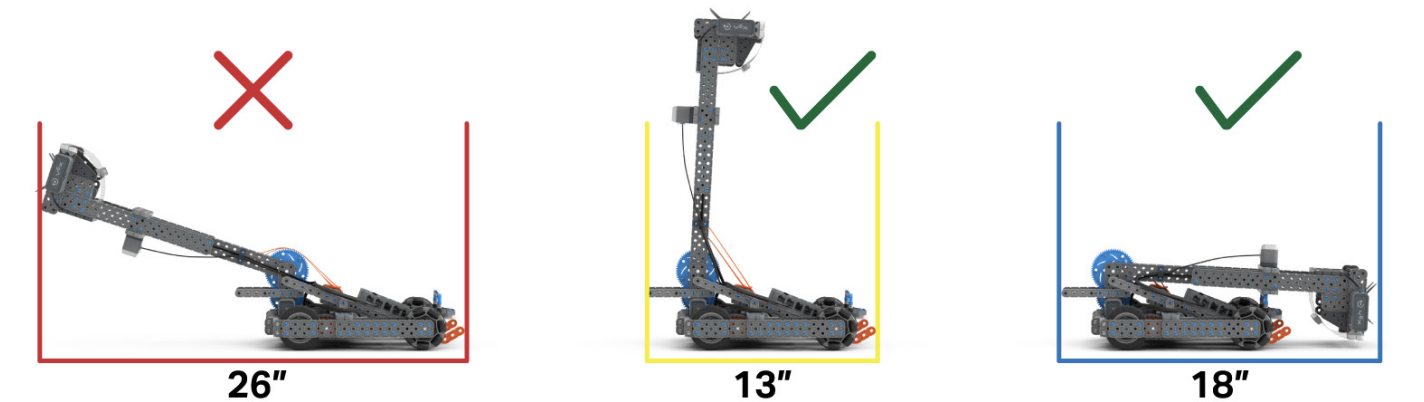
The horizontal limit is the one that produces judgment calls, because a robot can drift past it without the team intending to. The moment to watch is when a mechanism arcs, swings, or deploys upward: as it rises it can push the robot's footprint outward, and the footprint has to stay within 11" by 24" at every point in that motion, not just when the robot is at rest. If you can't tell whether a robot cleared the limit mid-motion, that is the situation to flag and judge, since the team is responsible for keeping the footprint legal even while a vertical mechanism is in use.
Boundaries and Field Conduct
Two rules keep the robot and the team where they belong during a match. Under <GG4>, Drive Team Members keep their hands out of the field — they may not make intentional contact with a robot, field element, or scoring object once the match is underway, except for the specific handling allowances covered in the next lesson. Under <GG8>, a robot must stay together; teams may not intentionally detach parts or leave mechanisms on the field. A part that comes off unintentionally is no longer part of the robot and can be left where it is or collected during a legal robot reset.
Neither of these is usually a hard call. A hand that reaches into the field, or a part deliberately dropped to gain an advantage, is visible when it happens. What takes more judgment is damage, which the next section covers.
Accidental Versus Intentional Damage
Rule <GG9> prohibits robot interactions that damage the field or its elements, and <S1> lets you disable or disqualify a team whose robot or actions are unsafe or have caused damage. For the purpose of <GG9>, "damage" means something that would need to be repaired before the next match can begin, like a goal knocked loose from the field.
In practice, almost all field contact in a VEX IQ match is accidental. A robot reaching for a scoring object clips a goal, or tips and dislodges an element on the way down. When that happens, you give the team the benefit of the doubt, the field is repaired, and play continues. A one-time, incidental result is not a violation.
The rare exception is damage a team causes on purpose. That line is drawn by <G5>: an accidental violation is treated differently from one a team commits knowingly to gain an advantage. What tells them apart is the pattern — a single unlucky contact reads differently from a robot repeatedly ramming a field element at full speed, or a mechanism used to pry or hook part of the field. Repeated or deliberate damage is not excused as "accidental," and under <GG9> and <S1> you may disable or disqualify at your discretion, with the robot requiring re-inspection before it takes the field again. This is uncommon in VEX IQ, but it is where the distinction matters.
Contact between the two partner robots is treated the same way. Because they work toward one score, there is no opponent to protect and no advantage to be gained by interfering, so most robot-to-robot contact is incidental and not something you rule on. Two partner robots bumping while reaching for the same scoring object is ordinary gameplay, not damage and not a call.
When Judgment Is Required
The sections above cover the clear cases — a footprint plainly over the limit, a hand in the field, a robot rammed on purpose. Most of the time, though, an action falls somewhere in between, and the job is deciding whether it crosses from expected play into a boundary, size, or damage question at all. A few questions can help you sort it:
- Did this affect the score or the safety of the match, or was it incidental?
- Was it a one-time result, or is it happening repeatedly?
- Does the team appear to be doing it on purpose to gain an advantage, or did it just happen in the course of play?
When the answer is genuinely unclear, <G3> settles it: teams are given the benefit of the doubt for accidental or edge-case situations. That benefit is not unlimited; repeated or strategic infractions are still called, but a single ambiguous moment resolves in the team's favor. Applied consistently from one match to the next, this keeps your calls predictable and keeps the focus on students playing the game as intended.