


Chapter 5: Match Play
Lesson 2: Loading and Possession

Learning Objectives:
- Identify when and how a Bean Bag may be legally introduced through a Load Zone.
- Describe how robots and Loaders may interact with a Load Zone.
- Identify the possession limit and the difference between possession and plowing.
- Identify what a robot must do when it is possessing or plowing more than one Bean Bag.
- Identify when a Bean Bag is considered out of the field and cannot be reintroduced.
Once a match is underway, most of what a Head Referee watches comes down to how Bean Bags move: how new ones enter the field, how many a robot may handle at once, and when one is gone for good. This lesson covers the Load Zone first, then the possession and plowing limit, and finally what happens when a Bean Bag leaves the field.
Before continuing, read the following from the current Game Manual:
- <SG4> Keep Scoring Objects in the Field
- <SG6> Possession is limited to one Bean Bag
- <SG7> Using the Load Zone
Loading Through the Load Zone
New Bean Bags enter the field during the match through the Load Zone — a segment of the floor at each short end of the field, where the team's Loader places them. Under <SG7>, Bean Bags are loaded one at a time:
- Red and blue Bean Bags only into the matching-color Load Zone
- Each placed flat on the floor and fully inside the zone
- Only when no other Bean Bag is already touching that Load Zone.
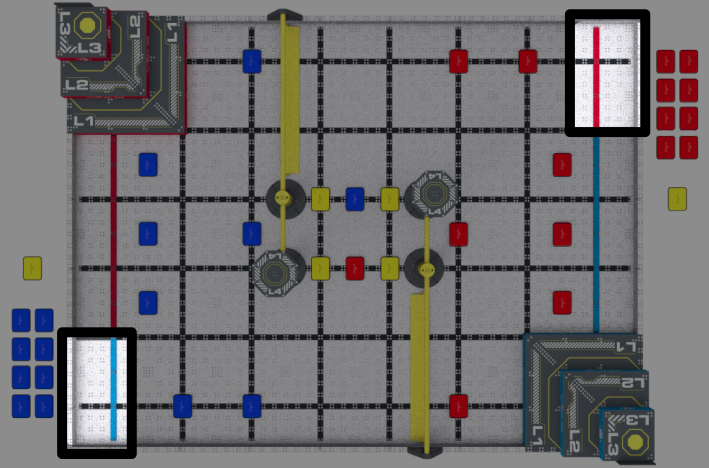
The rule that takes the most watching is simple to state: a robot and a human may never touch the same Bean Bag at the same time. A robot may not contact a Bean Bag while the Loader is still touching it, and the Loader may not touch it again once it's been released. So the handoff is one-way — the Loader places and releases, then the robot may take it. Because a robot crowding the Load Zone can make that moment hard to judge, the manual recommends (though doesn't require) that robots stay back until the Loader's hand is clearly away.
If a Bean Bag is loaded improperly, like the wrong color for that zone, or while another Bean Bag is still in contact with the Load Zone, the Loader retrieves it and reintroduces it only if the Head Referee instructs them to. Nothing about an improper load is punitive on its own; your job is simply to have it corrected so play continues cleanly.
The Possession Limit
Under <SG6>, a robot may possess and/or plow only one Bean Bag at a time. A robot that ends up interacting with more than one must immediately stop all actions except trying to remove the extra. It cannot keep driving, scoring, or maneuvering while holding two. The intent is plain: one Bean Bag per robot at a time.
Both possessing a Bean Bag (controlling it — fully supported by the robot, or held that if the robot moved in any direction it would maintain control of the Bean Bag) and plowing one (pushing it ahead with a flat or convex face) count toward that single-Bean-Bag limit. So a robot already possessing one Bean Bag cannot also plow a second, and the moment a robot has more than one under control, everything it does other than releasing the excess is a violation.
When Contact Becomes Plowing
The limit itself is easy to state; what takes judgment is deciding when a robot's contact with a second Bean Bag crosses from harmless into plowing. This is the call <SG6> explicitly leaves to the Head Referee, and it comes down to the difference between incidental contact and plowing:
- Incidental contact — a robot brushes a Bean Bag in passing and it barely moves. This is not plowing, and it doesn't count against the limit. Robots share the field with loose Bean Bags, and momentary bumps are expected.
- Plowing — a robot pushes a Bean Bag in a deliberate direction across a meaningful distance. The manual's rule of thumb is roughly a tile-length (~300mm or 12 inches) or more than greater-than-momentary contact.
The tile-length guideline is a starting point, not a bright line. The manual is explicit that the final determination is yours. The practical version at the field: a robot carrying one Bean Bag that clips another in passing is fine; the same robot deliberately shoving that second Bean Bag along the floor is over the limit.
When a Bean Bag Leaves the Field
A Bean Bag that leaves the field during a match is gone for the rest of the match. Under <SG4>, Scoring Objects that leave the field are not returned and cannot be reintroduced by the Loaders.
A Bean Bag has "left the field" when it is:
- Outside the Field Perimeter,
- No longer touching the floor or a Field Element, and
- Not supported by any robot or Scoring Object still inside the field.
Note that a Bean Bag resting on top of the Field Perimeter and not touching anything outside it is still considered inside the field, and it may not be retrieved by a Drive Team Member or volunteer. So "on the perimeter" is in; "over the perimeter and unsupported" is out.
Two clauses here can surprise new referees, so they're worth holding onto:
- A deflection back in doesn't save it. If a Bean Bag is on its way out and a Drive Team Member, field monitor, wall, or ceiling knocks it back onto the field, <SG4> still applies — it's considered out, and you remove it.
- Ending up in the Pyramid Goal structure counts as out. A Bean Bag that ends up inside the Pyramid Goal structure is treated as out of the field.