


Chapter 7: Violations, Penalties, and Documentation
Lesson 3: Serious Penalties, Documentation, and Team Conversations

Learning Objectives:
- Describe what a Disqualification is and how it differs from a Disablement.
- Describe how Disqualifications apply in Teamwork, Finals, and Robot Skills Matches.
- Identify what information should be recorded after a match.
- Explain the team appeal process and identify who may discuss match rulings with the Head Referee.
- Describe how to respond appropriately to disagreement and keep interactions with teams positive.
Most violations never rise to a serious penalty. When one does, your job has three parts: apply the penalty correctly, record it, and talk it through with the team. In VEX IQ, that last part deserves as much care as the first two — the person hearing your ruling may be young and at their first competition, and how you deliver the news shapes whether they leave the field discouraged or ready for their next match.
Before continuing, review the following in the current Game Manual:
- <GG6> Disqualifications.
- The Disablement and Disqualification definitions in the Glossary (Appendix C).
- <T1> Head Referees have ultimate and final authority, including the requirement to record Violations.
- <T3> The Drive Team Members are permitted to immediately appeal the Head Referee's ruling.
Disablement and Disqualification
These two penalties are easy to mix up, but the difference is simple. A Disablement is a safety penalty: it is applied during the match, at the moment a robot is unsafe, and the team may not operate its robot for the rest of the match. A Disqualification is the result of a Major Violation: it is a scoring outcome, usually applied after the match ends. A robot can be Disabled without being Disqualified, and a team can be Disqualified without ever being Disabled.
How a Disqualification lands depends on the type of match:
- Qualification Match — Applies only to the team that committed the violation. That team receives zero points, while the other team on their alliance still receives points.
- Finals Match — Applies to the whole alliance, which receives zero points.
- Robot Skills Match — The team receives a score of zero for that match.
Repeated violations or Disqualifications for a single team can, at the Head Referee's discretion, lead to Disqualification for the entire event, but that is rare.
Documenting the Violation
Whenever you issue a Minor or Major Violation, you should attempt to notify the team as the violation occurs, and after the match you must point to the specific rule number that was broken and record the violation in the Match Anomaly Log.
At a minimum, capture:
- The team that committed the violation
- The match in which it happened
- The rule number
- Whether it was a Minor or Major Violation
Fill it in as part of your after-match wrap-up, while the details are fresh. This record keeps your calls consistent, gives you something to reference if a decision is questioned, and meets the documentation requirement in <T1>. A violation should never be a secret or a surprise — between your verbal and physical indications during the match and your conversation afterward, teams should not walk away from the field uninformed.
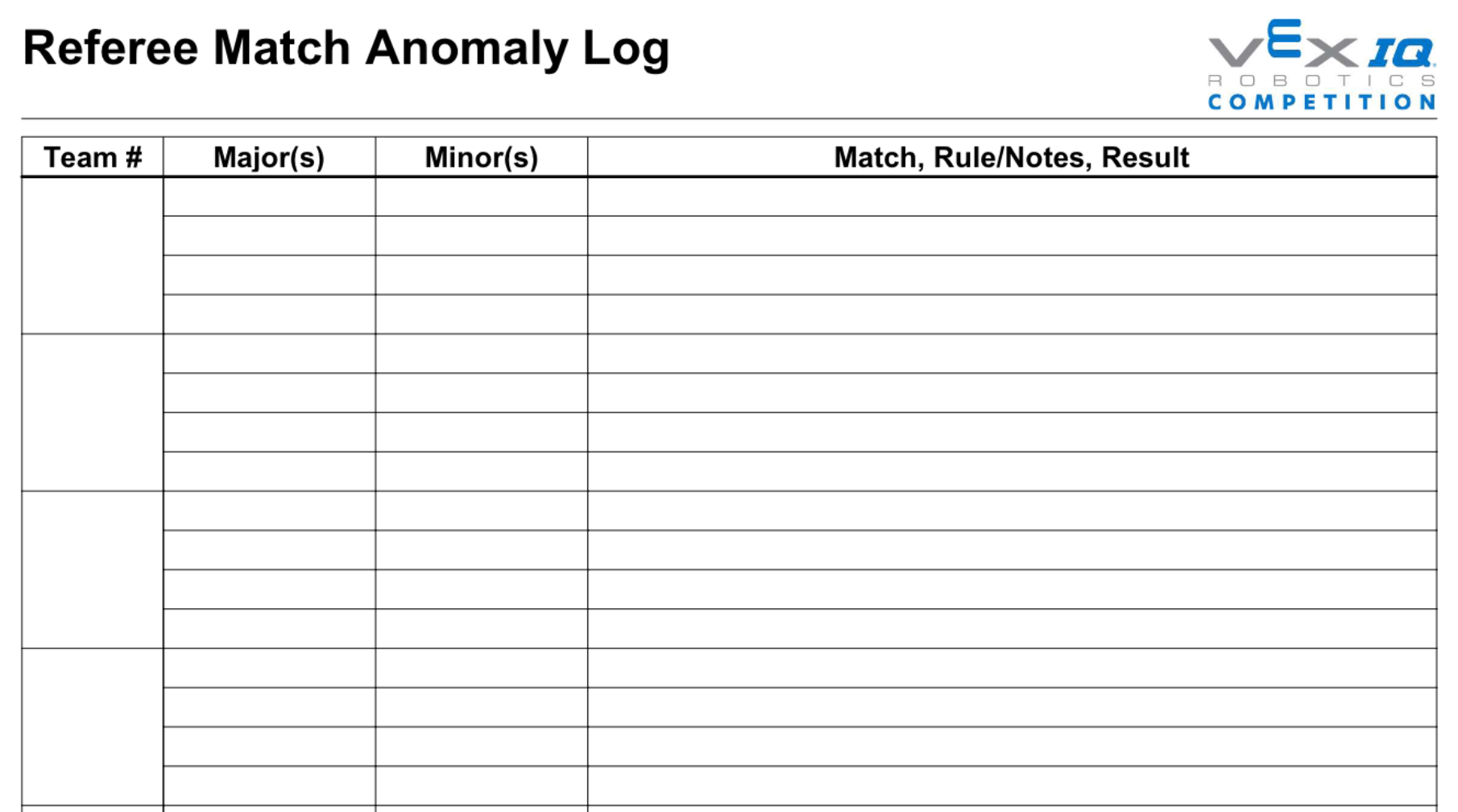
This log can be found in Tournament Manager. Talk with your Event Partner to get a physical or digital copy of the log to use throughout the event.
The Team Appeal Process
Teams are allowed to disagree with you, and the Game Manual gives them a clear path for it. If Drive Team Members wish to dispute a score or ruling, they must stay in the Driver Station until the Head Referee talks with them. You may choose to meet with them at another location or a later time if you need to reference the Game Manual or other resources — take that option whenever you are unsure; a short delay is better than a rushed answer. Some events also offer a "question box," a designated spot for these conversations, though a team appealing something about the state of the field should stay at the Driver Station until you have seen the context.
Two boundaries keep this process orderly:
- The Head Referee is the only person permitted to explain a rule, Disqualification, or Violation to teams. Students should never be sent to Scorekeeper Referees or other field personnel for a ruling.
- The appeal belongs to the students. Drive Team Members are the ones permitted to raise it, in keeping with the Student-Centered Policy (<G2>).
Once you announce that your decision is final, the issue is over and no more appeals may be made. There is no system for appealing further, either at or after the event, and refusing to accept a final decision may be considered a <G1> Violation.
Keeping the Conversation Positive
The Game Manual makes a point worth taking to heart: communication and conflict resolution are life skills that students are here to practice. A nine-year-old walking up to an adult referee to question a call is doing something genuinely hard. Treat the appeal itself as a good thing, even when the answer is no.
The Code of Conduct applies to everyone in these conversations, referees included. It asks everyone to speak and act respectfully under pressure, and it asks that disagreements be raised through official processes, not pressure or confrontation. The appeal process gives students that official path, and your role is to model the respect the Code expects in return
You do not need to be an educator to handle these conversations well. A few tactics go a long way:
- Get on their level. Crouch or lean to meet younger students eye to eye, and let them say their piece before you respond. Be mindful of your facial expressions, and maintain a kind and open posture throughout the conversation.
- Use plain words, not rule citations. Lead with what happened: "Your robot was still moving after the timer hit zero, so that last Bean Bag can't count." The rule number belongs in your log and is available if they ask.
- Name the feeling, hold the ruling. "I can see you're disappointed — you drove a great match" costs nothing and changes nothing about the call.
- End with the next match. Young students often recover faster when pointed forward: "Now you know for next time — that's exactly how this works."
- Match the student, not the age group. Some fifth graders will debate rule text with you; some eighth graders will be near tears. Read the student in front of you and adjust accordingly.
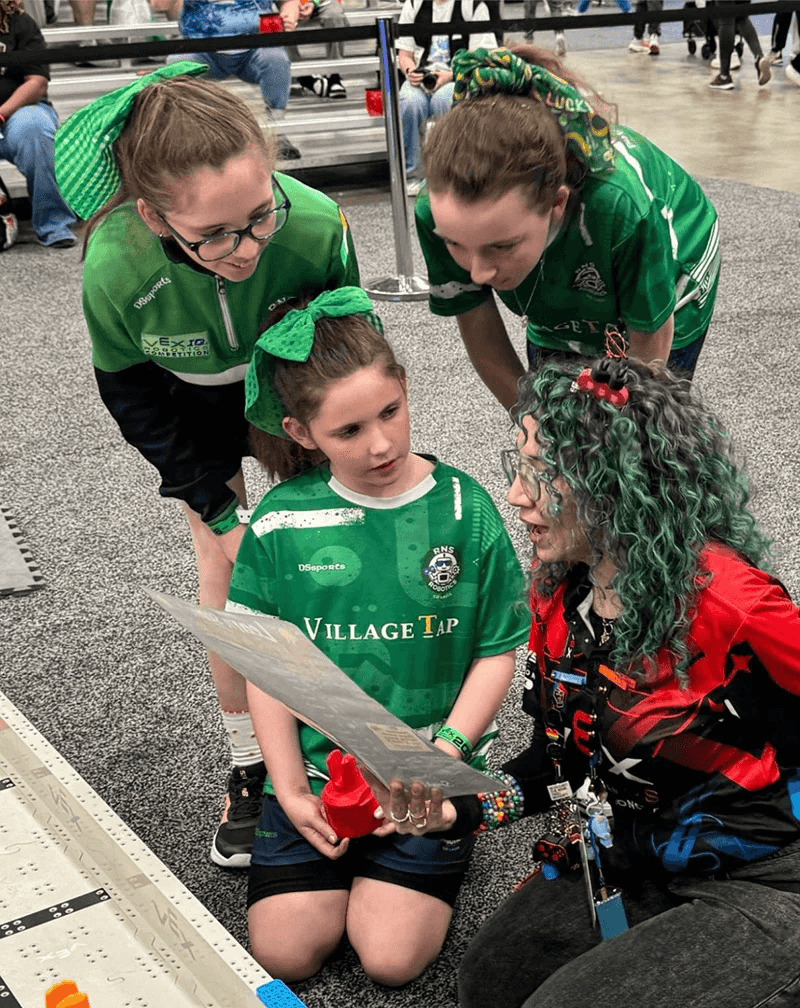
Remember: You can be warm and still be final. Kindness is in your tone, your patience, and your willingness to explain — not in changing a correct ruling. Holding the line consistently is itself a form of respect: it tells every student their match was judged by the same rules as everyone else's.