


Chapter 3: Interviewing Teams
Lesson 2: Talking with Students

Learning Objectives:
- Identify who, what, and where Team Interviews are held.
- Identify how the Sample Questions in the rubric can be used during the interview.
- Identify strategies for asking follow-up questions during the interview.
- Describe how to foster student comfort and confidence during a Team Interview.
The previous lesson covered the shape of an interview and the rubric you score it with. This lesson covers the conversation itself. It is a conversation with students who are usually delighted to talk about what they built, and your interest in hearing it is most of what makes it work.
Who, What, and Where
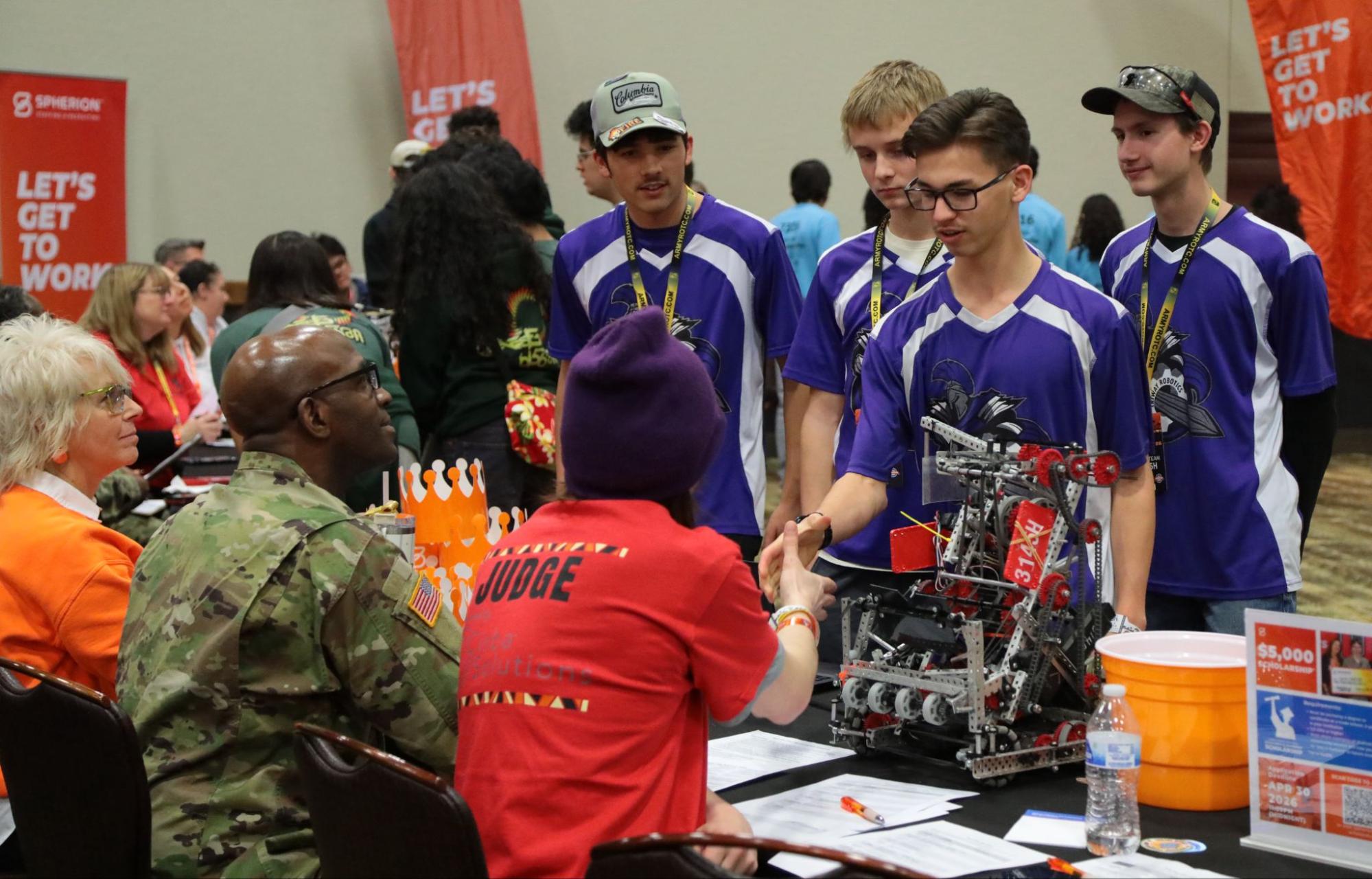
A Team Interview is a short conversation between two judges and one team. Your Judge Advisor will let you know which teams to interview and approximately how long you have for each. Interviews are held in the pit area or another public location at the event.
Interviews are held with the whole team present, not part of a team, and no single student is expected to answer everything. Different students will likely speak to different parts of the robot or season, which is what working on a team looks like.
Students may refer to whatever they have on hand while they talk — the robot itself, their code, or their Engineering Notebook if it is with them. Reaching for something to point at is not a lack of preparation. It is a strategy to help teams explain their own work.
Coaches, mentors, and parents may be nearby for supervision and support, but the interview is of the students, and they are the ones you are talking to and hearing from.
Opening the Interview
Introduce yourself and your judging partner, and give students a moment to settle. You are two strangers with clipboards, and a few seconds of ordinary friendliness changes what the next several minutes sound like.
- If the team submitted a Season Summary, open with the highlight you picked. It starts the conversation on ground the team is already proud of.
- Otherwise, open with one of the rubric's Sample Questions, printed at the top of each section and written to get a team talking.
- “Pick a part of your robot or code, walk me through how it works and why you built it that way.”
- The Sample Questions are conversation starters rather than a specific list to work through, and all of them are open-ended on purpose: ask one, then let the answer decide what you ask next.
Moving the Conversation Forward
Your main job is to start the conversation and then step back and listen. A good follow-up comes from what a student just told you, not from anything printed on a page. Follow where students take you and let them speak to their strengths — you are not there to find what a team cannot do.
- The most useful follow-up is usually the simplest one. When an answer arrives thin, ask about the part they skipped.
- Student: "We changed our intake because it wasn't really working." Judge: "What was it doing when it wasn't working?" Student: “It kept dropping blocks when we came in at an angle, so we tried rubber bands on the rollers and that fixed it.”
- A polished answer is a starting point, not the whole conversation. Teams prepare for interviews, and that is exactly what we ask them to do — sounding rehearsed is not doing anything wrong. But a prepared answer is the part the team planned to tell you, so ask about something they may not have planned for.
- “What surprised you the most while you were building that?”
- Keep an ear on the rows you have nothing for. A topic that never comes up cannot be scored. When you notice a row sitting empty, reach for a Sample Question from that section and steer there.
- “Tell me about a time your team disagreed about what to do. How did you decide?”
Closing the Interview
Wrap up the interview as you started it, on a friendly, positive note. There should not be a question of whether the interview is over or not.
- End with an open invitation. One final question can give you a little more at the end of an interview, and can also be useful if the conversation stalls:
- "Is there anything else you think we should know about your team, your robot, or your code?"
- Thank the team, and leave the scoring out of it. Students sometimes ask how they did. Scores stay within the judging team and awards are decided later, so there is nothing to report. Thank them for their time and tell them you enjoyed hearing about their season.
Helping Students Feel Comfortable
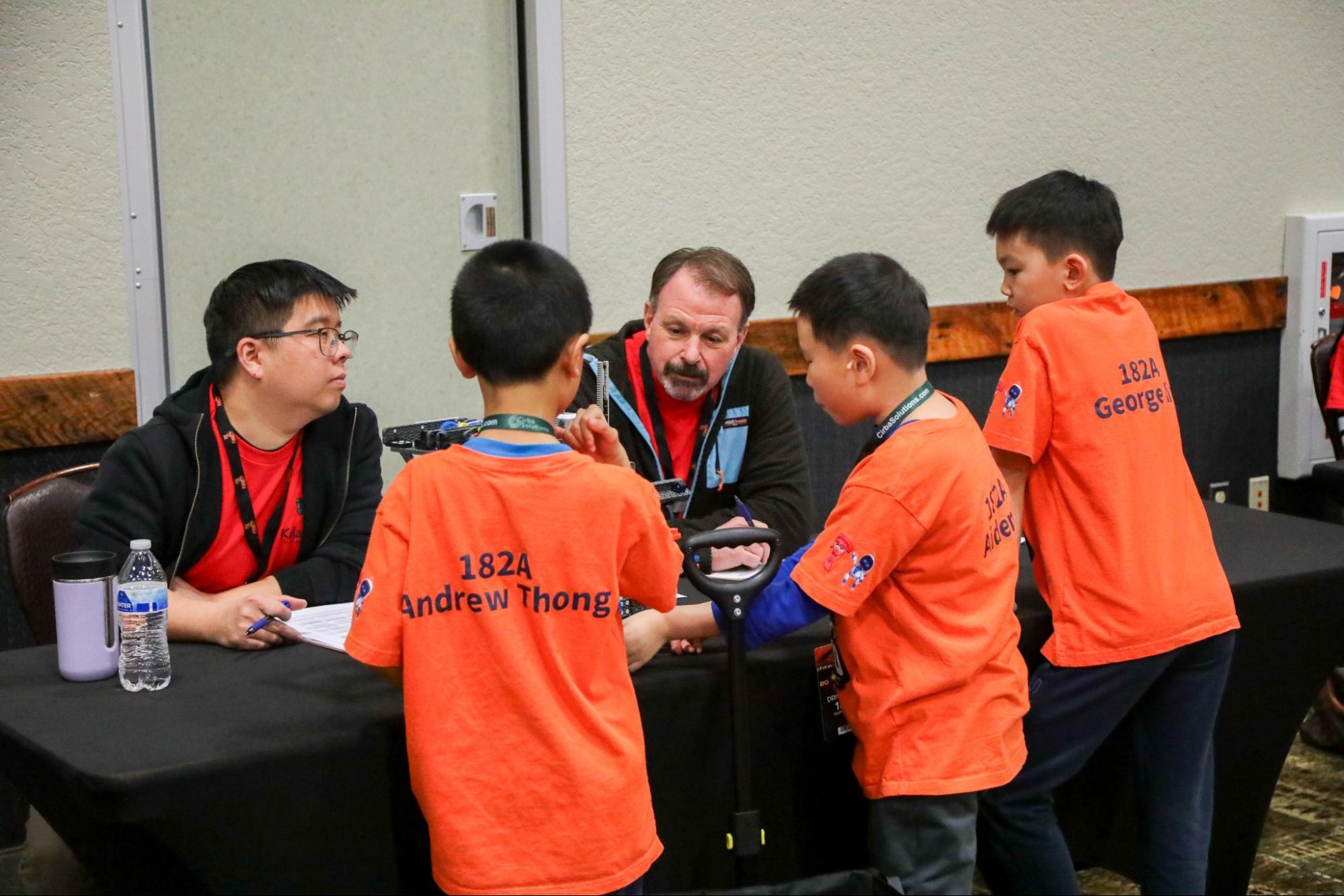
An interview should feel like a friendly conversation. Students are explaining work they care about to two adults they met a minute ago, which takes a little nerve, and rapid-fire questions will close that down quickly. Kindness here is not only good manners. Comfortable students talk more and tell you more, and what they tell you is what you have to score, so making it easy for them to talk works in your favor.
This applies from the moment you walk up to the moment you leave. Students of all ages arrive with very different levels of comfort talking to adults they have never met. Match the energy of the student in front of you rather than expecting them to come to you. An eight-year-old may talk your ear off; a self-conscious fourteen-year-old may need more prompting to get going. Age tells you very little about which one you are about to meet, and assuming that younger students are less capable presumes a great deal about students you have just met. Every team is different, so every interview is different.
A few habits help, most of them borrowed from teachers:
- Be a person, not a panel.
- Get on their level — if you are six feet tall and talking with an eight-year-old, sit or crouch so you are not standing over them.
- Make eye contact while students are speaking, and react honestly. Smiling, laughing, and being visibly interested puts students at ease. You are someone a student is likely excited to talk to, so share in their enthusiasm!
- Have one judge lead the conversation while the other takes notes, so someone's face is always engaged with the team rather than with a clipboard.
- Be patient, and let silence sit. A pause is usually a student thinking, and filling it for them ends the thought. If a question does not land, rephrase it rather than just repeating it louder.
- Encourage multiple voices without calling on anyone. A team whose members build on what the last person said is doing well, and you do want to hear from more than one student. But putting a quiet student on the spot rarely produces what you were hoping for. The more common situation is the opposite: one student answering everything. Let them finish and make sure they feel heard, then offer the floor — “Did anyone else work on that part?”
- Listen to what students tell you, not how they tell it. Volume, polish, and fluency are not what you are scoring. An accent, an interpreter, a long pause, or an answer a student writes down instead of speaking is how that student takes part. A quiet answer full of specifics tells you more than a confident one with none.
If an adult, like a coach or parent, answers for a student, redirect politely and keep going. "Thanks, I'd love to hear that from the team." If it keeps happening, finish the interview and tell your Judge Advisor. Either way, score what the students said. A team should not lose points because an adult would not stop talking.