


Chapter 6: Loading and Possession Rules
Lesson 1: Possession During Match Play

Learning Objectives:
- Identify when a robot is possessing a Pin.
- Identify when a robot is possessing a Cup.
- Identify possession limits in a match.
- Distinguish between possessing a scoring object from simply pushing it across the field.
- Identify what a robot must do when it is possessing too many scoring objects.
Robots spend most of a match handling scoring objects, picking up Pins and Cups, carrying them, and placing them on goals. This lesson covers the concept of possession: what it means for a robot to possess a scoring object, how many it may possess, how possession differs from simply pushing objects across the field, and what a robot must do when it ends up with too many. These situations come up throughout the Driver Controlled Period, so a Head Referee needs a consistent way to judge them match after match.
Before continuing, read the following in the current Game Manual:
- <SG6> Possession is limited to a maximum of one Pin and one Cup.
- The definition of possession and its two examples in Appendix B.
What Counts as Possession
A robot is possessing a scoring object when it is controlling the object, not just touching or pushing it. A useful test: if the robot turned, would the object go with it? The Game Manual defines possession two ways, and meeting either one is enough to constitute being possessed.
- The scoring object is fully supported by the robot — lifted or carried, with the robot holding its weight.
- The robot maintains control in all directions — the object stays (or would stay) with the robot as it turns and drives forward, backward, left, and right.
That second test is the one to run in your head during a match: if the robot moved in any direction right now, would the object still be with it? If the object would be left behind by even one direction of travel, the robot is not possessing it.
The same test applies to both scoring objects. There is no separate rule for Pins and Cups, the one definition applied to both. The clearest cases are lifting or carrying an object, or holding it in an intake or gripper — the Game Manual's own example is a scoring object held in a robot's intake, either in the air or along the floor.
Possessing vs. Pushing
Not every object a robot moves counts as possessed. A robot pushing scoring objects ahead of it across the field is moving them, not controlling them: the moment it reverses, the objects stay behind. Objects being pushed this way do not count toward the possession limit, so a robot may push a whole cluster of Pins across the field without violating <SG6>.
The shape of the robot is not what decides this. The Game Manual is explicit that objects pushed along the floor are not possessed whether the face doing the pushing is flat, convex, or concave. What matters is whether control holds up in every direction, not what the mechanism looks like.
What this means for the referee: Judge the control, not the mechanism. A concave scoop, a curved bumper, or a pair of arms is not possession on its own — if the robot would lose the objects the instant it backed away, it is pushing them, however it is shaped. Conversely, a robot does not have to lift an object to possess it; a Pin held in an intake along the floor is possessed if it travels with the robot in every direction. When you are unsure, ask the core question: if this robot drove forward, backward, left, right, or turned, would the object most likely stay with it?
Possession Limits
Possession is capped at one Pin and one Cup at a time. A robot may control up to one Pin and up to one Cup at the same moment, but never two Pins or two Cups.
If a robot ends up possessing too many scoring objects — more than one Pin, or more than one Cup — it must immediately stop all actions except trying to remove the excess. Getting back within the limit is the only thing the robot may do.
If the robot cannot remove the extra object, it must return to a legal starting position, as described in <SG1>. While it is over the limit, the robot cannot interact with Toggles, goals, or other scoring objects, and it will not be eligible for Midfield points if the match ends while it remains over the limit.
Possession Example 1
It is the Driver Controlled Period. A robot picks up a Cup with a Pin nested inside it and carries it toward a goal, fully supported in its claw.
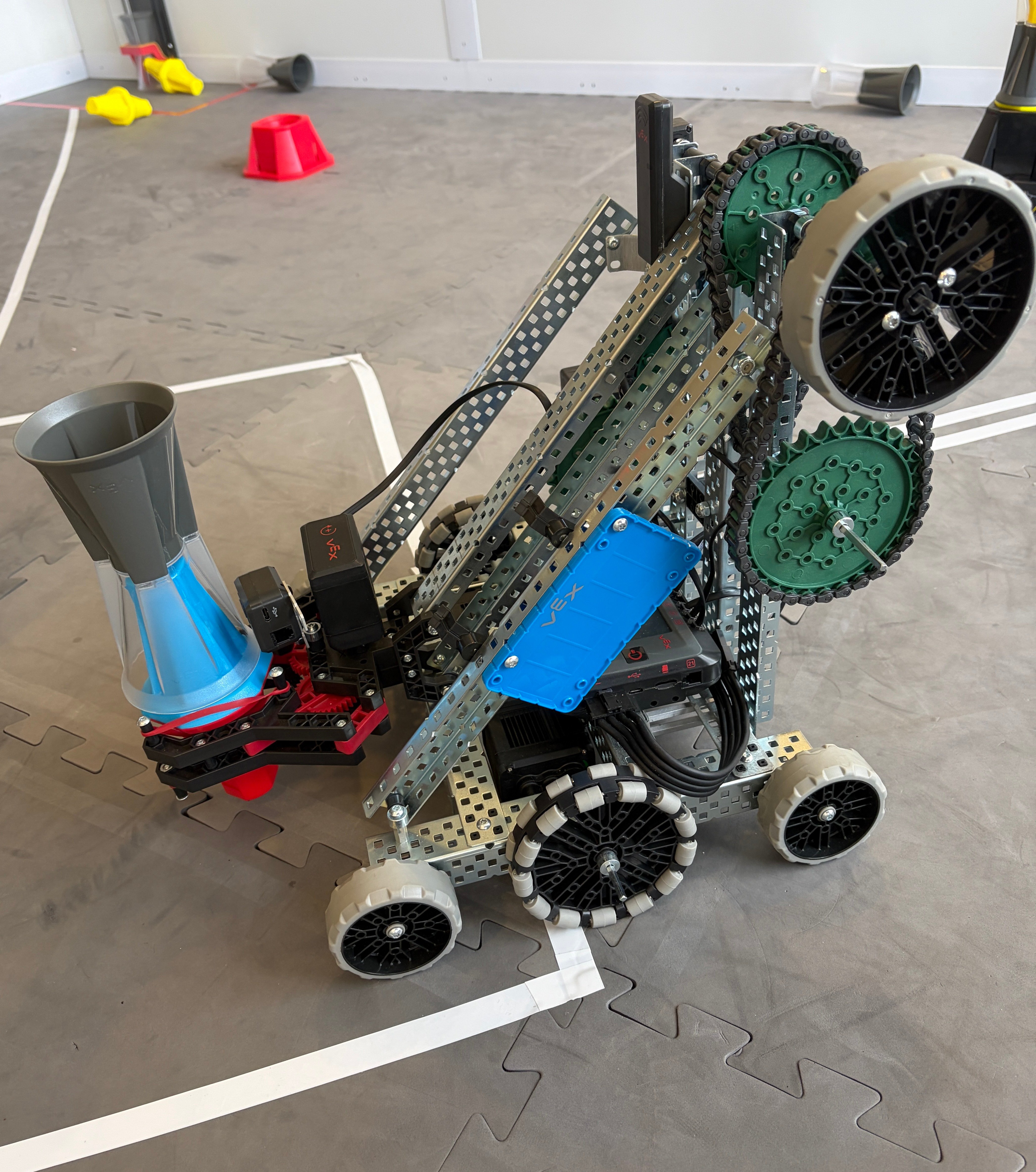
Is this legal? Yes — it clears the checklist:
- Possession: Yes, the nested Cup and Pin is fully supported in the claw
- Number of Pins: One (the nested Pin)
- Number of Cups: One (the Cup it is nested in)
A nested Cup and Pin counts as one of each, so the robot is at the possession limit, not over it. Nothing here requires referee intervention.
Possession Example 2
It is the Driver Controlled Period. A robot is already carrying one Pin in its claw when it scoops up a second loose Pin; both Pins are now pressed against the robot as it drives toward a goal.
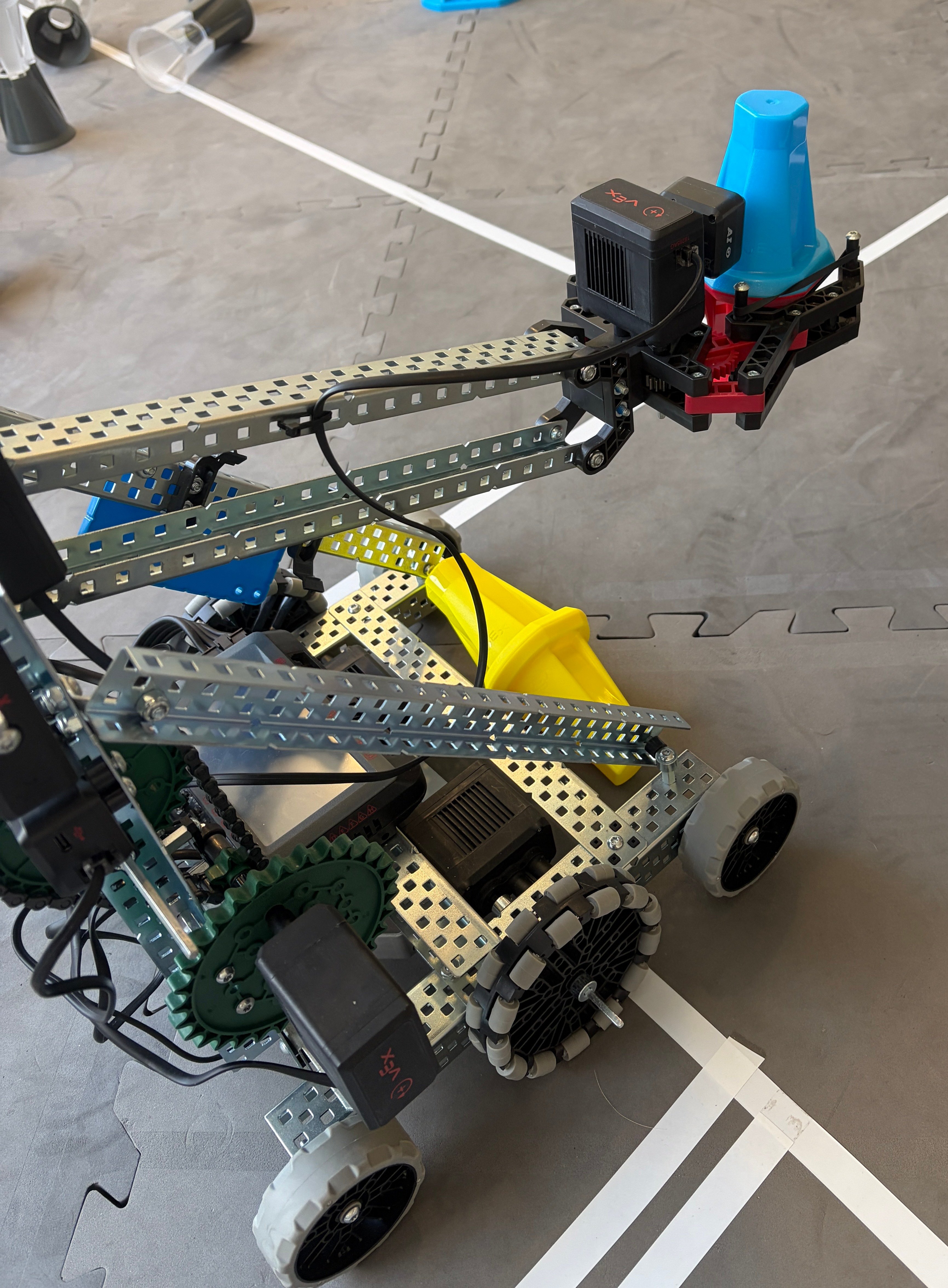
Is this legal? Also, yes:
- Possession:
- The Blue Pin is being possessed.
- The Yellow Pin is not possessed.
- If the robot moved forward, back, left, and right, the Pin would not move with the robot in every direction, meaning it is not possessed.
- Number of Pins Possessed: One
- Number of Cups: Zero