


Chapter 5: Starting a Match and Autonomous Period Rules
Lesson 1: Starting a Match

Learning Objectives:
- Identify legal and illegal match starting setups.
- Describe starting position requirements for robots.
- Identify Preload requirements before the match begins.
- Identify when a Head Referee should intervene before a match starts.
Every match begins the same way: robots placed on the field, Preloads set, Drive Team Members in position, and controllers connected. Before the timer starts, the Head Referee is responsible for confirming that this setup is legal. A match that starts from an illegal setup can create scoring problems, safety concerns, or disputes later, so it is worth getting right before play begins.
In Chapter 1, you learned that the referee team checks field and robot readiness before a match. This lesson focuses on what the Head Referee specifically needs to confirm and when they should step in. One of those things is the Preload — the single Pin (one per robot) that each team places in contact with its robot before the match begins. Every robot starts the match with one Preload, and confirming it is set legally is part of the Head Referee's pre-match check.
Before continuing, read the following rules in the current Game Manual:
- <SG1> Starting a Match
- <SG5> Each Robot gets one Pin as a Preload
- <GG11> Controllers must stay connected to the Field
It also helps to be familiar with <GG2> (robots should attend every match) and <GG3> (robots that delay the start of a match). These rules are the official source for exact criteria. This lesson focuses on how to apply them at the field.
Robot Starting Positions
Rule <SG1> lists every criterion a robot must meet before a match. Rather than memorizing the list, you can think of it as confirming a few things about each of the four robots.:
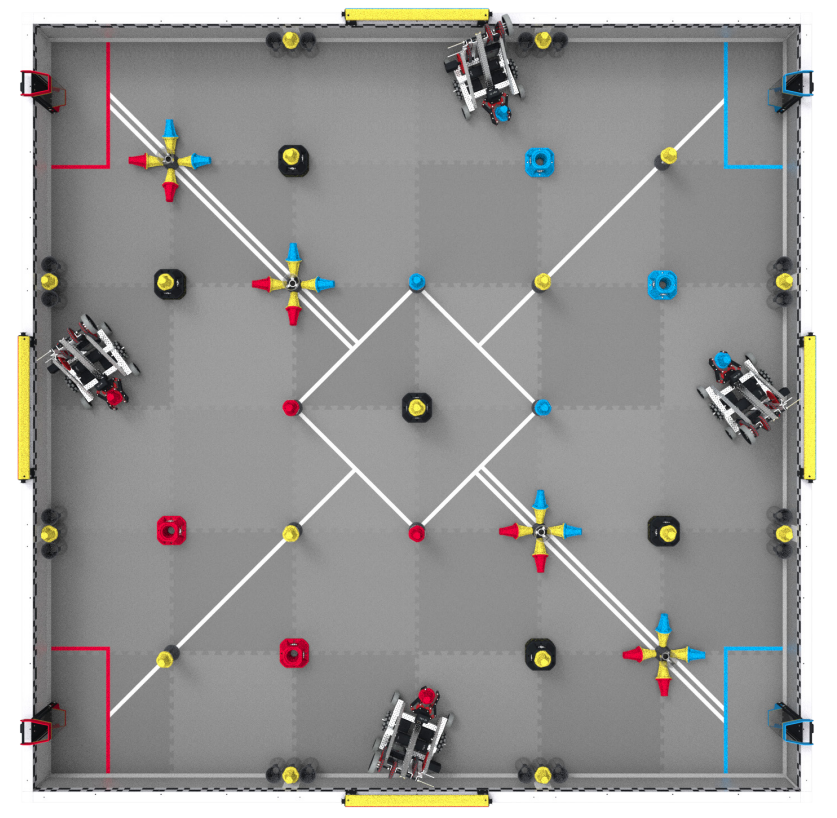
- Size and stillness — the robot fits within the 18" × 18" × 18" starting size and is completely stationary.
- What it is touching — the robot is not contacting goals, Loaders, Load Zones, Toggles, or any scoring object other than its one Preload.
- Where it is — the robot is on its own alliance's side of the Autonomous Line, touching the field tiles and perimeter, and not sharing a Quadrant with another robot.
If a robot does not meet all of these criteria, it is not in a legal starting position. As the Head Referee, your job before the match is to confirm each of these conditions for all four robots. A robot that is touching a goal, overlapping another robot's Quadrant, or moving when the match is about to begin needs to be corrected before play starts.
One detail in <SG1> is easy to miss: a robot may lean on its Preload or the Field Perimeter to hold its starting shape, but only if it would still pass inspection and meet the size rule without that support. A robot that needs its Preload to stay within size is not legal.
Preload Requirements
Each robot starts with one Pin as a Preload, and <SG5> sets the conditions for how the Preload is placed. The practical version:
- Each robot has exactly one Preload.
- The Preload is the correct color for that alliance (red/yellow for Red, blue/yellow for Blue).
- It is touching only that one robot — not another robot, another Preload, or any goal, Loader, Load Zone, or Toggle.
So before the match, the check is simple: each robot must have exactly one correctly colored Preload, touching only its own robot.
When the Head Referee Should Intervene
Most matches start without any issues. When something is off, resolving it before the timer starts is the Head Referee's responsibility. The most common reasons to step in:
- A robot is not in a legal starting position under <SG1>.
- A Preload is missing, the wrong color, or set illegally under <SG5>.
- A controller is not plugged into the field's control system, which <GG11> requires before the match.
- A team raises a concern about how a field element or scoring object is set. Under <GG4b>, these concerns must come to the Head Referee before the match, and team members may never adjust field elements or other scoring objects themselves.
A separate situation is a robot that is delaying the start. Under <GG3>, a robot that is not ready promptly may be removed from the field at the discretion of the Head Referee and Event Partner, so the schedule can continue. A robot not placed on the field before the match starts cannot be added once play is underway.
As in Chapter 1, the goal is to be both efficient and accurate — confirm the setup, correct what needs to be corrected, and keep matches moving. When you do step in, a short, clear instruction before the match prevents a dispute after it.