


Chapter 5: Starting a Match and Autonomous Period Rules
Lesson 2: Autonomous Period Rules

Learning Objectives:
- Identify legal and illegal Autonomous interactions.
- Identify how robots can legally interact with the Midfield and Autonomous Line during the Autonomous Period.
The Autonomous Period is the first 15 seconds of a Head-to-Head Match, when robots run on their own and Drive Team Members cannot touch the controls. In Chapter 2, you learned how the Autonomous Bonus and Autonomous Win Point are scored. This lesson covers the rules that govern what robots and teams may do during those 15 seconds, so you can recognize a legal Autonomous interaction from an illegal one.
The defining idea of Autonomous is separation. The Autonomous Line is the pair of white tape lines that run diagonally across the field and around the Midfield, along with the space between those lines. Each alliance plays on its own side of it, and humans stay hands-off. Two areas of the field (the Midfield and the scoring objects on the Autonomous Line) are shared, and a different standard applies there.
Before continuing, read the following rules in the current Game Manual:
- <SG7> Don't cross the Autonomous Line, and don't interfere with your opponents' actions
- <SG8> Engage with the Midfield and/or Autonomous Line during the Autonomous Period at your own risk
- <GG12> Autonomous means "no humans"
- <GG13> All rules still apply in the Autonomous Period
No Humans During Autonomous
Under <GG12>, Drive Team Members may not interact with their robots in any way during the Autonomous Period — directly or indirectly. That includes touching the controls, unplugging or interfering with the field connection, and manually triggering sensors, even without contact. If a Drive Team Member acts on the robot during Autonomous, the interaction is illegal.
The one narrow exception is safety: with the Head Referee's permission, a team may Disable their robot during Autonomous by holding the power button, for example if the robot is behaving dangerously.
Staying on Your Own Side
The core rule of <SG7> is separation by the Autonomous Line. During the Autonomous Period, a robot may not contact foam tiles, scoring objects, or field elements on the opposing alliance's side of the line. Autonomous play is meant to be offensive — focused on your own scoring — not defensive disruption on the opponent's side.
Defensive disruption is what <SG7> is guarding against, and it can take a few forms: a robot reaching across the line to knock away an opponent's Pins, contacting an opponent's robot to interfere with its routine, or pushing scoring objects onto the opponent's side. Each of these is illegal. The most serious cases carry a real consequence — under <SG7>, contacting an opponent's robot or scoring objects on the far side of the line awards the Autonomous Bonus and an Autonomous Win Point to the opposing alliance, unless that alliance also broke Autonomous rules.
The Midfield and the Line Are Shared
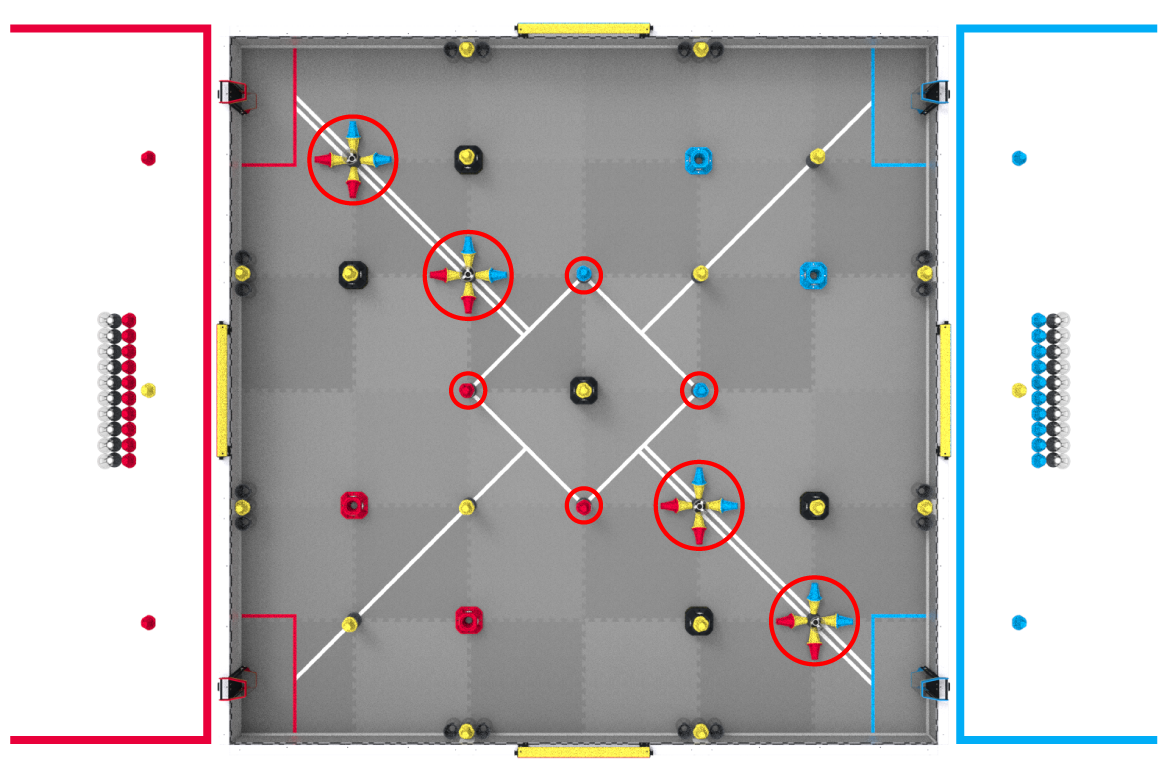
The Midfield and the scoring objects that begin the match on the Autonomous Line are the exception to "stay on your side." Both alliances are allowed to use them. A scoring object that starts the match touching the Autonomous Line is not considered to be on either side, so either alliance may go for it — and all objects that start on the Autonomous Line are counted as being on the line. These Pins and Cups are highlighted in the image below from the Game Manual.
<SG8> frames this as engaging "at your own risk." Because both alliances can pursue the Midfield and the line, robots will contact each other there, and that contact is expected. When two robots are both legitimately engaging with the Midfield or the line, an incidental collision — even one that tips a robot or bumps it off course — generally is not a violation on either side. The risk is the team's own: a robot that tips itself over entering the Midfield does not get to claim a violation against the opponent it bumped.
This is not a free-for-all, though. The shared zone is neutral, not lawless. A robot that goes after an opponent which is not engaging with the Midfield or line, or that uses the shared area as cover for reckless or destructive play, can still draw a violation at the Head Referee's discretion. A referee is watching for the difference between two robots legitimately contesting the Midfield and one robot using the Midfield as an excuse to target an opponent.
A Note about Head Referee Discretion:
This is one of the first places in the course where a decision comes down to the Head Referee's discretion, and it will not be the last. The Game Manual is built to give you the tools to make these calls with confidence — clear rules, definitions, and violation guidance you can lean on. But the rules cannot script every interaction on a fast-moving field, and some moments will come down to your understanding of what happened and what the rule intends. When that happens, use the manual to ground your reasoning, then trust your judgment and make the call. Making a clear, well-reasoned decision and communicating it effectively are part of the role.