


Chapter 7: Robot Interaction and Judgment Calls
Lesson 2: Holding, Pinning, Trapping, and Lifting

Learning Objectives:
- Identify when a robot is Holding an opponent.
- Describe the difference between Pinning, Trapping, and Lifting.
- Apply the 3-count during Holding interactions.
- Identify when a Holding count should stop or reset.
- Describe how verbal and visual referee communication helps teams avoid violations.
Holding is the most structured robot interaction you will manage. Like most contact in Override, it is legal — a robot may block, push, and contest position. It only becomes a violation when one robot keeps an opponent from moving or escaping past the 3-count. Your role here is less about catching a violation and more about managing the interaction with a clear, audible count so that teams can separate before a penalty ever happens.
Because the timing is built into the rule, Holding is one of the few interactions where the count you keep, out loud and with your hand, is part of officiating the match. The goal of this lesson is to help you get comfortable with that count, and with what starts and stops it.
Before continuing, read the following in the current Game Manual:
- <GG17> No Holding for more than a 3-count.
- The Holding, Pinning, Trapping, and Lifting definitions in the Glossary (Appendix B).
What Counts as Holding
A robot is Holding an opponent when it prevents that opponent from moving or escaping. Ordinary contact is not Holding. The Game Manual groups three specific interactions under Holding:
- Pinning — Preventing an opponent's movement through contact with the Field Perimeter, a Field Element, or another robot.
- Trapping — Confining an opponent to a small area, about one foam tile or less, with no avenue for escape.
- Lifting — Controlling an opponent's movement by raising or tilting it off the floor.
One distinction matters before you start a count. For Pinning and Trapping, the opponent must actually be trying to escape. If a robot is not attempting to move, it is not being pinned or trapped — this often happens when a robot has stopped on its own, has malfunctioned, or is choosing to sit and defend a Field Element. Lifting is the exception: a lifted robot has lost control of its own movement, so Holding begins the moment the opponent is lifted, whether or not it is trying to escape.
The Holding Count
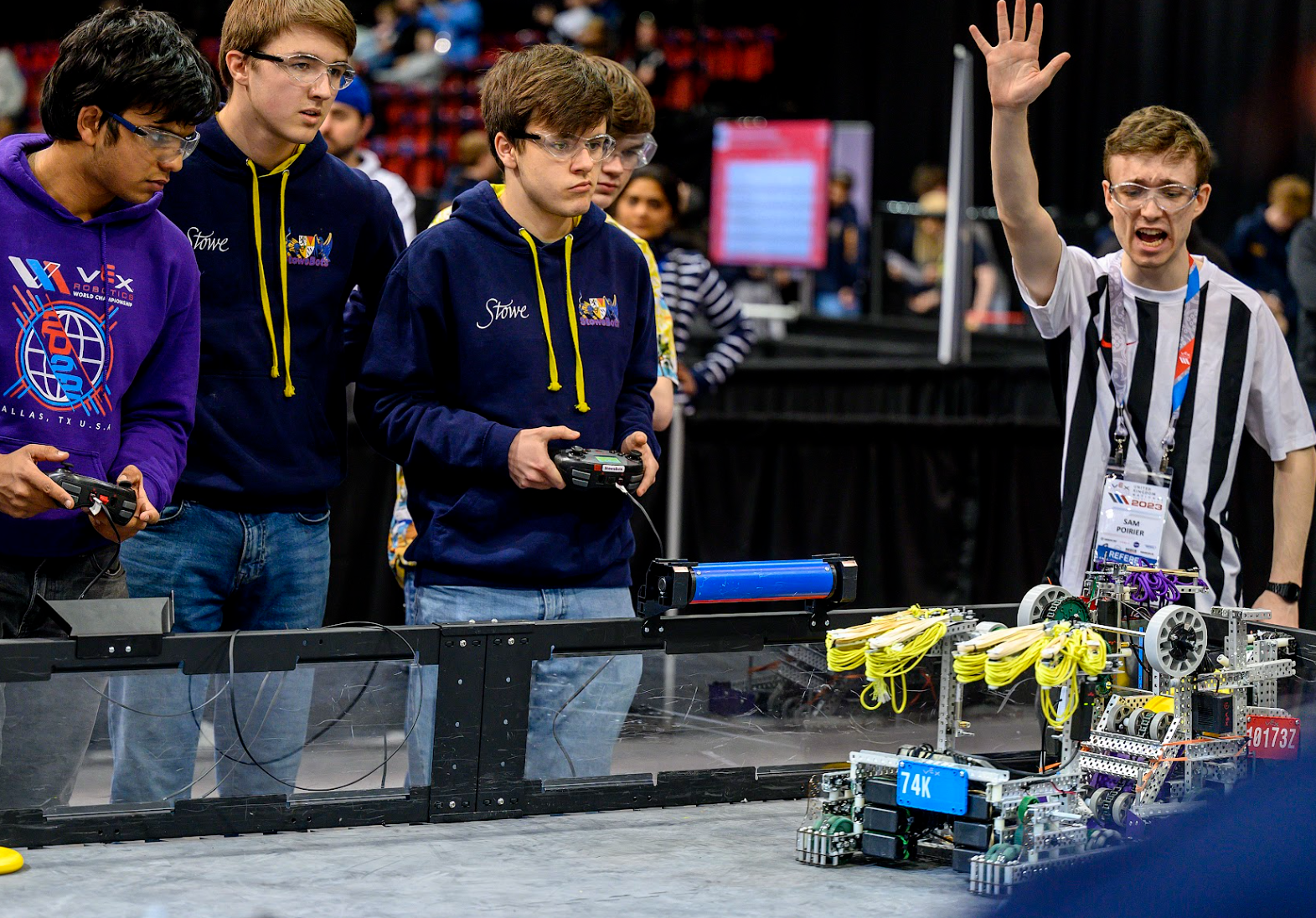
Under <GG17>, a robot may not hold an opponent for more than a 3-count during the Driver Controlled Period. A count is about one second, spoken out loud by the Head Referee. Start the count immediately when you suspect Holding — do not wait until you are certain. When Drive Team Members can hear the count and see your hand, they will usually separate on their own before it reaches three, which is how a good count helps teams avoid penalties rather than collect them.
Starting a count is not the same as calling a violation. If the contact stops meeting the definition of Holding, you wave the count off, and that is not a statement that Holding happened. Holding becomes a violation only if the count passes three before the robots separate.
When the Count Stops or Resets
Stop the count as soon as any one of these is true:
- The robots separate by about one foam tile.
- Either robot moves about one foam tile from where the Pinning or Trapping began (for Lifting, from where the lifted robot is set back down).
- The Holding robot is itself trapped or pinned by a different robot — the first count ends and a new one begins for the newly held robot.
- For Trapping, an avenue of escape opens up.
A robot cannot reset the count by briefly backing away. After a count ends, the robot must wait out a 5-count before Holding the same opponent again, and if it returns within that 5-count, the original count picks up where it left off.
How Holding violations are formally classified is covered in a later chapter. Here, the goal is to recognize Holding and keep an accurate, clearly communicated count so most teams correct themselves before it ever reaches that point.