


Chapter 6: Loading and Possession Rules
Lesson 2: Match Loads and Loaders

Learning Objectives:
- Identify when and how Match Loads can be introduced.
- Describe how robots can interact with the Loaders.
- Explain how Load Zones are protected during the Driver Controlled Period.
Once the Autonomous Period ends and the Driver Controlled Period begins, teams need a way to keep new scoring objects coming onto the field. They do this through the Loaders, by introducing Match Loads. This lesson covers when and how a team may legally introduce a Match Load, how a robot may interact with a Loader to bring those objects into play, and how Load Zones are protected so that loading can happen without interference. Loading happens constantly during live play, so a Head Referee needs to recognize a legal introduction from an illegal one quickly and call violations consistently.
This lesson focuses on Head-to-Head Matches. Robot Skills Matches follow different loading procedures — for example, a team may only introduce Match Loads through the Red Alliance Loaders. If you need to reference those, see Chapter 3 and rule <RSC2> in the Game Manual.
Before continuing, read the following in the current Game Manual:
- <SG11> Match Loads may be introduced during the Match under certain conditions
- <SG13> Load Zones are protected during the Driver Controlled Period of the Match
- <GG4> Hands out of the Field
- The definitions of Loader, Load Zone, Match Load, and Scoring Object in Appendix B.
Loaders and Match Loads
A Loader is one of the four designated locations around the field — two per alliance — where Drive Team Members introduce Match Load Pins and Cups. A Match Load is a scoring object (a Pin, Cup, or nested Pin in a Cup) that an alliance brings into play through one of their Loaders during the match. Introducing a Match Load is the specific moment when a Drive Team Member releases a scoring object into a Loader.
Introducing Match Loads
Rule <SG11> describes the conditions for a legal Match Load. The items below summarize the rule for use at the field; they do not replace it. A legal Match Load comes down to four things:
- One at a time — a single Pin, a single Cup, or a nested Cup and Pin. All Match Loads must follow possession limits.
- Their own Loaders — into either of the team's own alliance-colored Loaders, not the opponent's Loaders.
- Driver Controlled only — during the Driver Controlled Period, never during the Autonomous Period.
- Top or back — through the top (when the Loader is down, as shown below on the left) or through the back (when a Drive Team Member raises it, as shown below on the right).
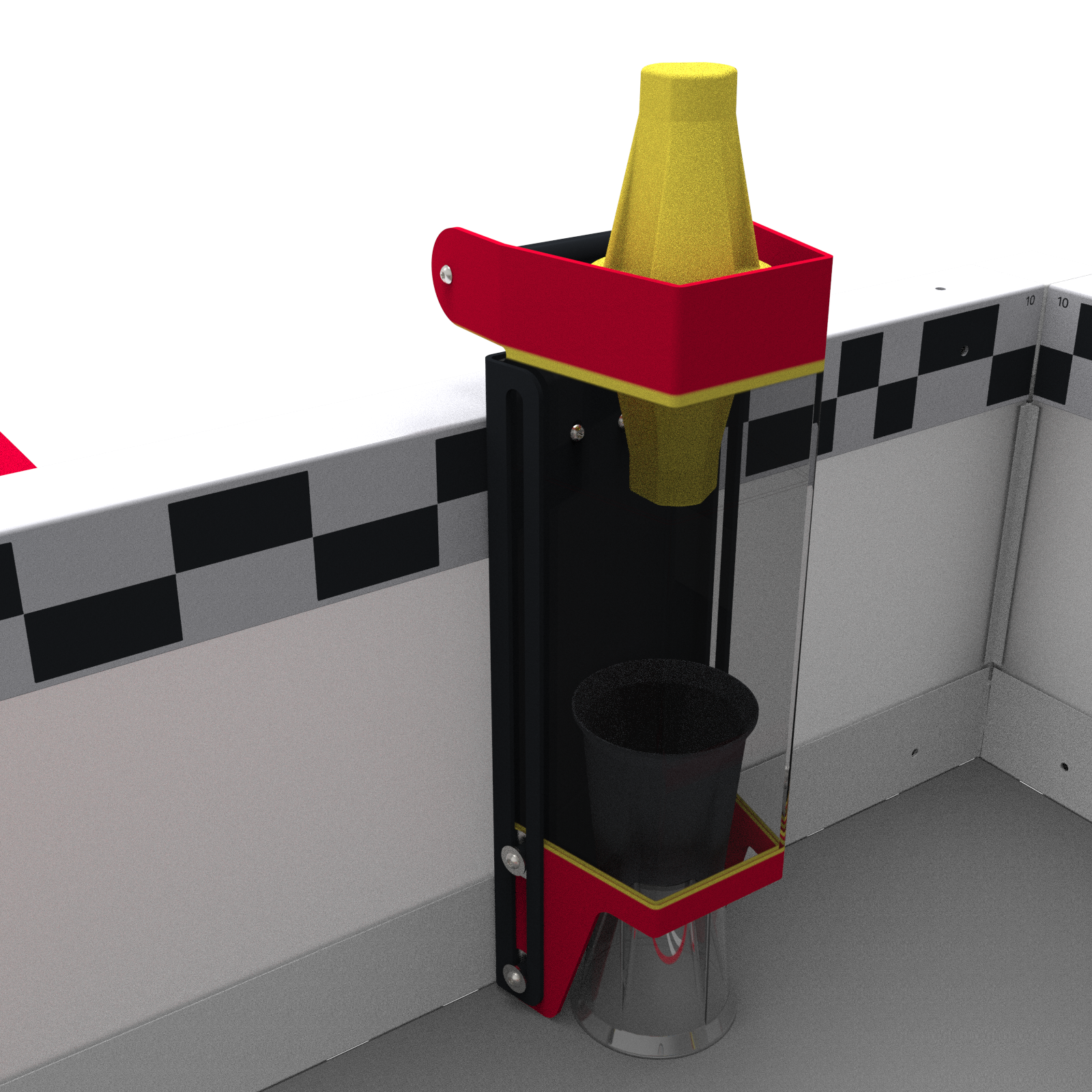
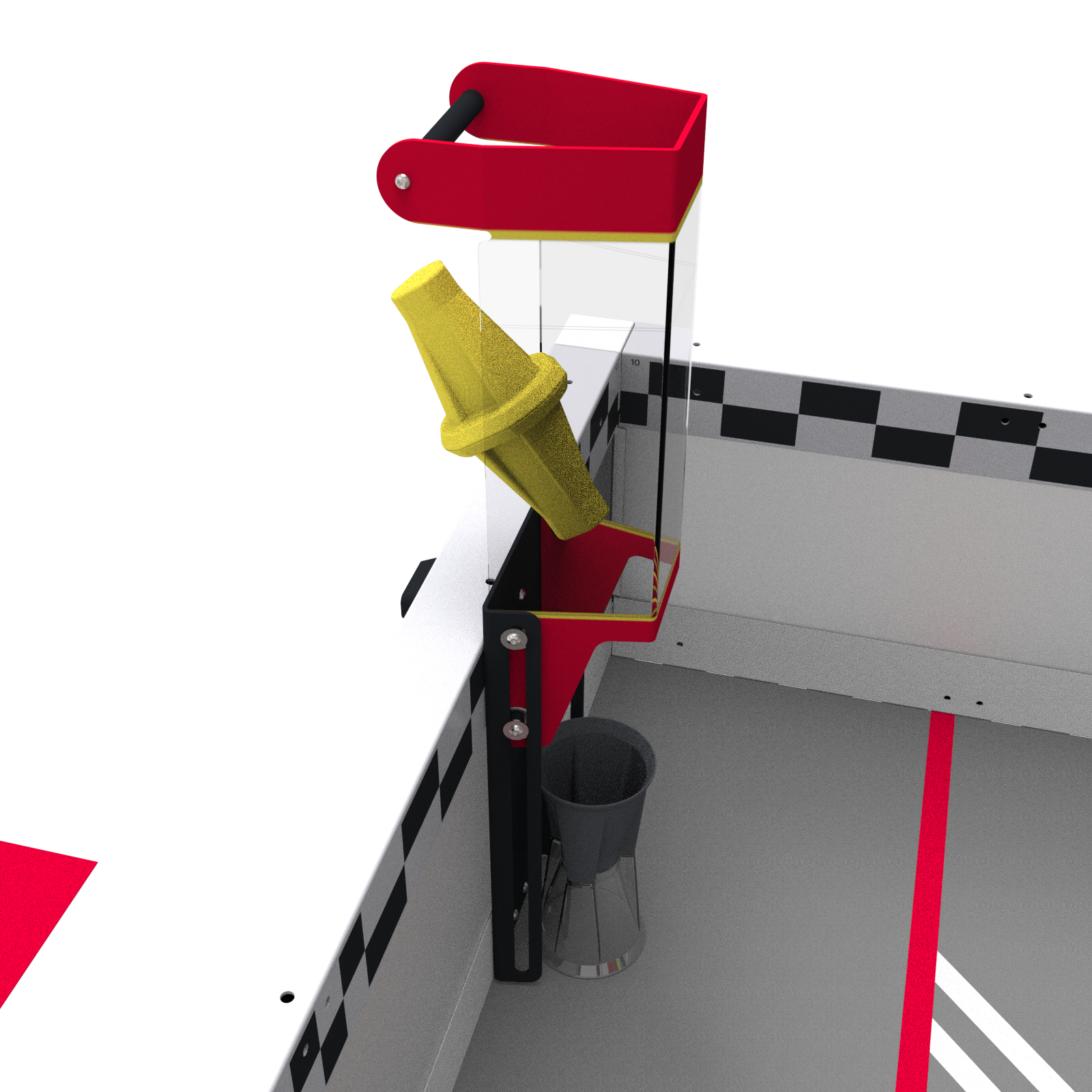
Loading is also the one moment during the match when a Drive Team Member's hands may cross into the field. Rule <GG4> normally keeps hands out, but releasing a scoring object into a Loader is an allowed exception. The exception is narrow, however: the rule covers releasing the object, not reaching into the Loader to position, adjust, or retrieve a Match Load. Unnecessary or unsafe loading actions may be treated as a violation of <S1> or <G3> at the Head Referee's discretion.
How Robots Interact with Loaders
Robots move Match Loads from the Loader into the rest of the field, and that interaction is also limited:
- Out the bottom only — a robot pulls Match Loads out through the bottom opening, never the top or back.
- Matching color only — a robot can only take from a Loader that matches its own alliance color, not the opponent's.
- Hands off until it's in — a robot cannot touch a Match Load until a Drive Team Member has released it into the Loader. A robot and a human cannot touch a scoring object at the same time.
- <SG11> allows there to be momentary contact between the Match Load, Drive Team Member, and the robot. Be sure to verbally warn teams when you feel that contact is going beyond an incidental moment.
Load Zones are Protected
A robot has to occupy the Load Zone in front of its Loader to collect Match Loads, so rule <SG13> protects Load Zones during the Driver Controlled Period. As with <SG11>, the items below summarize the rule for use at the field; they do not replace it. Load Zone protection comes down to three things:
- Protected while inside. A robot that is at least partially within one of its own Load Zones is protected. Opposing robots may not contact it, directly or indirectly.
- Passing through only. A robot may enter an opposing Load Zone momentarily, such as driving through it or retrieving a Scoring Object, but may not remain there.
- No blocking with objects. A robot may not cause Scoring Objects to accumulate within an opposing Load Zone.
The intent of <SG13> is to prevent intentional interference with Loader access. A robot parked in front of an opponent's Loader, or a pile of Scoring Objects pushed into the Load Zone, keeps that alliance from loading. This rule applies only during the Driver Controlled Period; it does not apply during the Autonomous Period.
Not every Scoring Object that ends up in a Load Zone is a violation; remember that normal gameplay moves objects around the field. Watch for robots deliberately herding objects into an opposing Load Zone, and for robots that linger there rather than passing through. An egregious violation of <SG13> is a Major Violation. An intentional violation is not automatically Major (that call is left to the Head Referee's judgment) and repeated minor violations may be escalated to a Major Violation at the Head Referee's discretion. You will learn more about violations in a later chapter.
When the Head Referee Should Intervene
Most loading happens without issue. When it does not, watch for things like:
- A team introducing more than one allowed Match Load at once
- Loading during the Autonomous Period
- Using the opposing alliance's Loader
- A robot contacting a Match Load before it is introduced
- A Drive Team Member reaching into the field beyond releasing the object
- A robot contacting an opposing robot that is protected within its own Load Zone
- A robot remaining in an opposing Load Zone instead of passing through
- A robot causing Scoring Objects to accumulate in an opposing Load Zone
The aim is to be efficient and accurate: a short, clear instruction or warning when a violation occurs helps keep the match moving and can prevent a dispute later. If a team continues to introduce Match Loads illegally after being warned, the infraction may be escalated to a violation at the Head Referee’s discretion. You will learn more about violations in a later chapter