


Chapter 9: VEX U for Head Referees
Lesson 2: VEX U Robot Rule Modifications

Learning Objectives:
- Identify VEX U robot size and starting-configuration differences.
- Recognize the robot-build allowances that are unique to VEX U (a second robot, custom-fabricated parts, additional motors and sensors) so they are not mistaken for violations.
- Describe how VEX U rules affect inspection-related Head Referee decisions.
- Recognize when a robot legality question should be reviewed using VEX U-specific rules.
VEX U provides additional opportunities for competitors to experiment with advanced manufacturing and engineering concepts in their robot design. This allows the competition to grow and level up with students as they move into the post-secondary space. In VEX U, teams run two robots, and can fabricate their own parts, 3D print components, and use motors, sensors, and pneumatics beyond what a standard VEX V5 Robotics Competition robot is allowed. The rules describing all of this are detailed and engineering-focused, and the full technical detail of those rules is the concern of inspectors, not necessarily Head Referees.
This lesson keeps the focus on what a Head Referee needs. You do not need to memorize materials lists or fabrication rules. You do need to recognize that a VEX U robot will legally look different from a standard VEX V5 Robotics Competition robot, know that robot legality is decided primarily through inspection, and know how to make a confident, well-sourced ruling on the occasion a question is brought to you. As always, Section 6 of the Game Manual is your source for the exact rules.
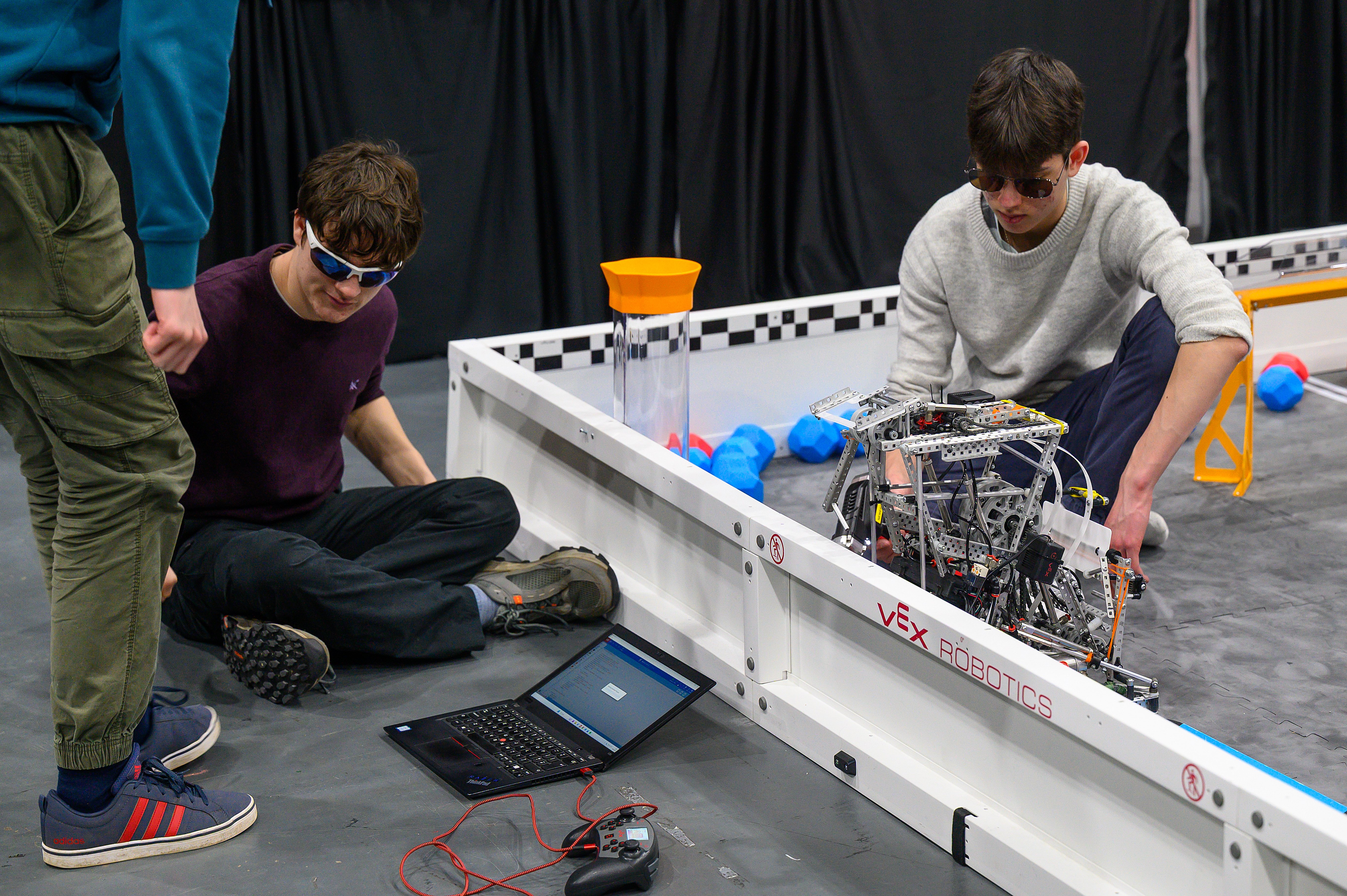
What a VEX U Robot Looks Like
The most useful thing a Head Referee can know about VEX U robots is that they are built to a much wider set of allowances than standard VEX V5 Robotics Competition robots. Things that would stand out as illegal on a standard V5 Override robot are routine in VEX U. The table below shows the differences you are most likely to notice at a VEX U competition.
| Element | VEX U | Standard VEX V5 Robotics Competition |
|---|---|---|
| Custom-fabricated and 3D-printed parts | Allowed, with documentation (See rules <VUR3> through <VUR7> for more details.) | Not allowed |
| Non-VEX springs, bearings, and fasteners | Commercially available versions allowed (See rules <VUR8>, <VUR9>, <VUR15> for more details.) | Limited |
| Motors and sensors | No restriction on the number of V5 Smart Motors or legal commercial sensors (See rules <VUR11> and <VUR12> for more details.) | Limited to set quantities |
The takeaway is that a VEX U robot may have custom parts, more motors, extra sensors, and a different size than you are used to — and that none of those are violations on sight. They are normal features of a legal VEX U robot.
Robot Legality Is Decided Through Inspection
In VEX U, as in standard VEX V5 Robotics Competitions, robots are checked for legality through inspection before they compete, and both of a team's robots must pass inspection. Inspectors are the people who work through the detailed build, materials, and fabrication rules. That is by design: those rules are written for the people examining the robot up close, not for the Head Referee during a Match.
Your role is the final-ruling authority. If a legality question comes up that an inspector, a volunteer, or a team cannot resolve, it may be brought to you. When that happens, you are expected to know where the answer lives and to make a clear, well-sourced call using the VEX U Section of the Game Manual.
Documentation Is Your Tool
When a question about a custom or fabricated part does reach you, the most useful rule to know is the documentation requirement in <VUR7>.
Under <VUR7>, any fabricated part must be accompanied by documentation — an engineering drawing of the part — that shows the team designed and built it themselves. Teams must provide this documentation when an inspector, Head Referee, or judge asks for it. If a team cannot produce acceptable documentation for a fabricated part, the part is deemed illegal for use.
This gives you a clear, fair way to handle a fabricated-part question without being an engineer: ask the team to show the documentation for the part. The question you are answering is not "is this part engineered correctly?" but "can the team support that they designed and built this part?" If they can, the part is supported. If they cannot, <VUR7> tells you how to rule.