


Chapter 8: Violations, Penalties, and Documentation
Lesson 3: Serious Penalties and Documentation

Learning Objectives:
- Describe what a Disqualification is and how it differs from a Disablement.
- Identify situations that may require a serious penalty.
- Describe how Disqualifications affect Qualification and Elimination Matches.
- Identify what information should be recorded after a match in the Match Anomaly Log.
Most violations never rise to a serious penalty. When one does, two responses sit at the serious end: a Disablement and a Disqualification. This lesson draws the line between them quickly, then focuses on the Disqualification — when it applies, how it plays out, and the short record you keep afterward.
Before continuing, read the following in the current Game Manual:
- <GG6> Disqualifications.
- The Disablement and Disqualification definitions in the Glossary (Appendix B).
- <T1> Head Referees have ultimate and final authority, including the requirement to record Violations.
Disablement and Disqualification
These two penalties are easy to mix up, but the difference is simple. A Disablement is a safety penalty: it is applied during the match the moment a robot is unsafe, and the team may not operate its robot for the rest of the match. A Disqualification is the result of a Major Violation: it is a scoring outcome — no points and a loss for the match — usually applied after the match ends. A robot can be Disabled without being Disqualified, and a team can be Disqualified without ever being Disabled. The rest of this lesson focuses on Disqualification.
When a Serious Penalty May Be Needed
A few situations commonly call for one of these responses:
- An unsafe robot or unsafe action — Addressed with a Disablement so the robot stops for the rest of the match.
- A Match Affecting violation — A Major Violation, which carries a Disqualification.
- An egregious, intentional, or strategic violation — Can be a Major Violation even when it is not Match Affecting.
- Repeated violations after warnings — Can escalate to a Major Violation at the Head Referee’s discretion.
How Disqualifications Play Out
How a Disqualification lands depends on the type of match:
- Qualification Match — The Disqualification applies to the team that committed the violation. That team receives a loss, zero points, and zero Win Points for the match, while its alliance partner is not disqualified.
- Elimination Match — The entire alliance is disqualified and receives a loss for that match, because alliances advance together.
Repeated Disqualifications for a single team across an event can, at the discretion of the Head Referee and Event Partner, lead to removal from the tournament, but that is rare.
Documenting and Communicating the Violation
Whenever you issue a Minor or Major Violation, you must be able to point to the specific rule that was broken, and you record the violation on the Match Anomaly Log. At a minimum, capture:
- The team that committed the violation
- The match in which it happened
- The rule number
- Whether it was a Minor or Major Violation.
This record keeps your calls consistent, gives you something to reference if a decision is questioned, and meets the documentation requirement in <T1>. Fill it in as part of your after-match wrap-up, while the details are fresh. Remember that teams should not walk away from the field uninformed of any violations they may have made during the match. A violation should not be a secret or surprise because of your verbal and physical indications during the match.
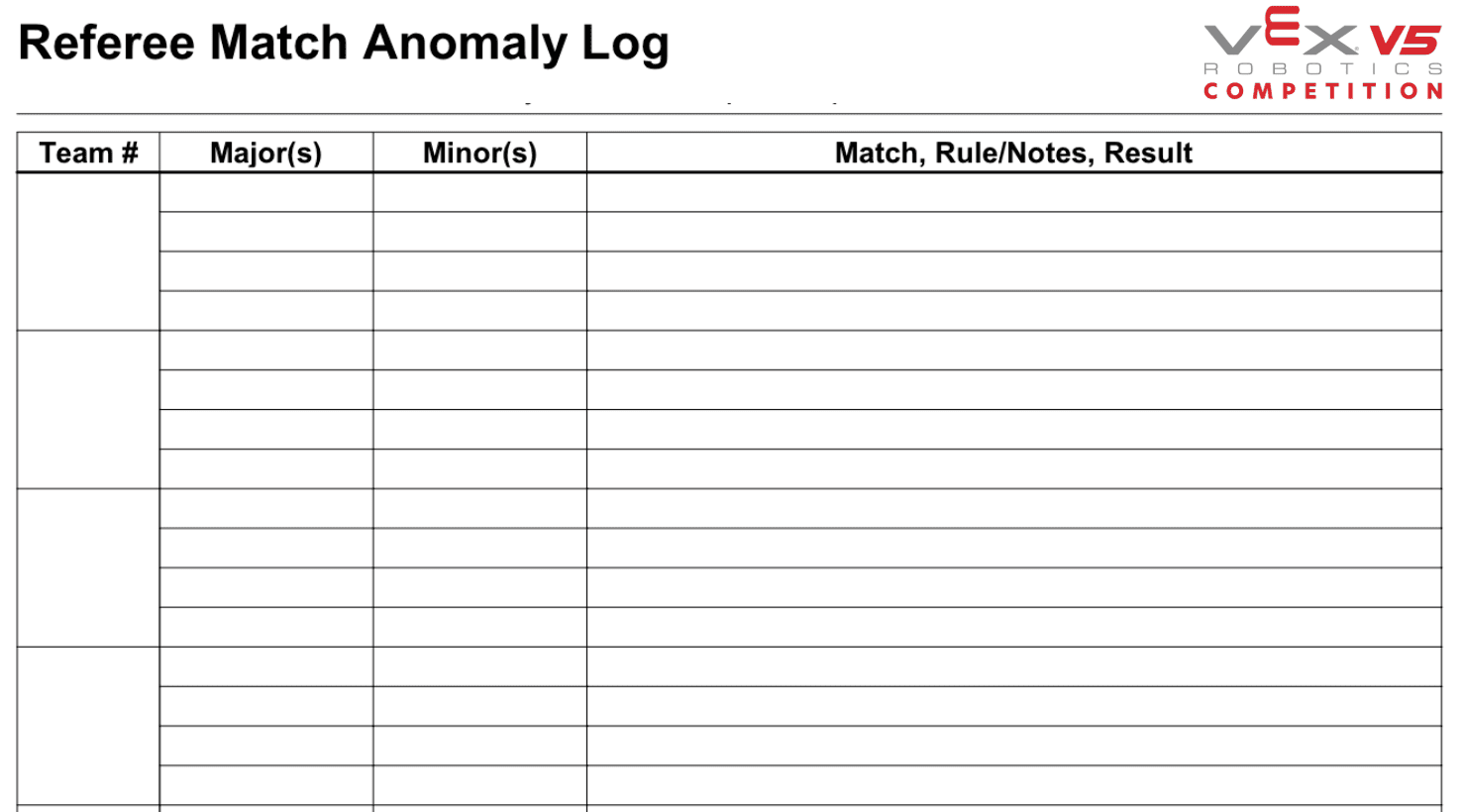
This log can be found in Tournament Manager. Talk with your Event Partner to get a physical or digital copy of the log to use throughout the event.