


Getting Started with a VEX Robotics Competition Game Manual

Every season, I hear some version of the same worry from coaches and teachers: "We haven't read the whole manual yet, so we can't really start." As a Senior Education Developer at VEX and a member of the VEX Game Design Committee, I'm here to give you permission to let that worry go. The manual is long because it has to be thorough, but it was never meant to be read cover to cover before your students touch a robot. It's a reference document, not a novel, and the moment your team starts treating it that way, the whole season gets easier.
We've heard the feedback loud and clear: the manuals are long and hard to consume. So let's talk about how to actually use one.
Why It Looks So Long
A Game Manual is built to answer questions you haven’t thought to ask yet. It accounts for the strange edge cases, the once-a-season ruling, and the situation nobody saw coming at your fall event. That comprehensiveness is exactly what makes it feel intimidating on day one, but it's also what makes it trustworthy in March.

Here's the reframe I wish I could share with every new coach: you don't read a dictionary front to back before you write a sentence. You learn enough to get going, then you look things up as you need them. The manual works the same way. Whether you're coaching VEX IQ or VEX V5, every VEX Game Manual—the VEX IQ Level Up Game Manual and the VEX V5 Override Game Manual alike—is organized precisely so you can jump to what you need, when you need it.
Start With the On-Ramps, Not Chapter One
The manual has built-in entry points that most people scroll right past. These work the same way across every VEX competition, so use them first:
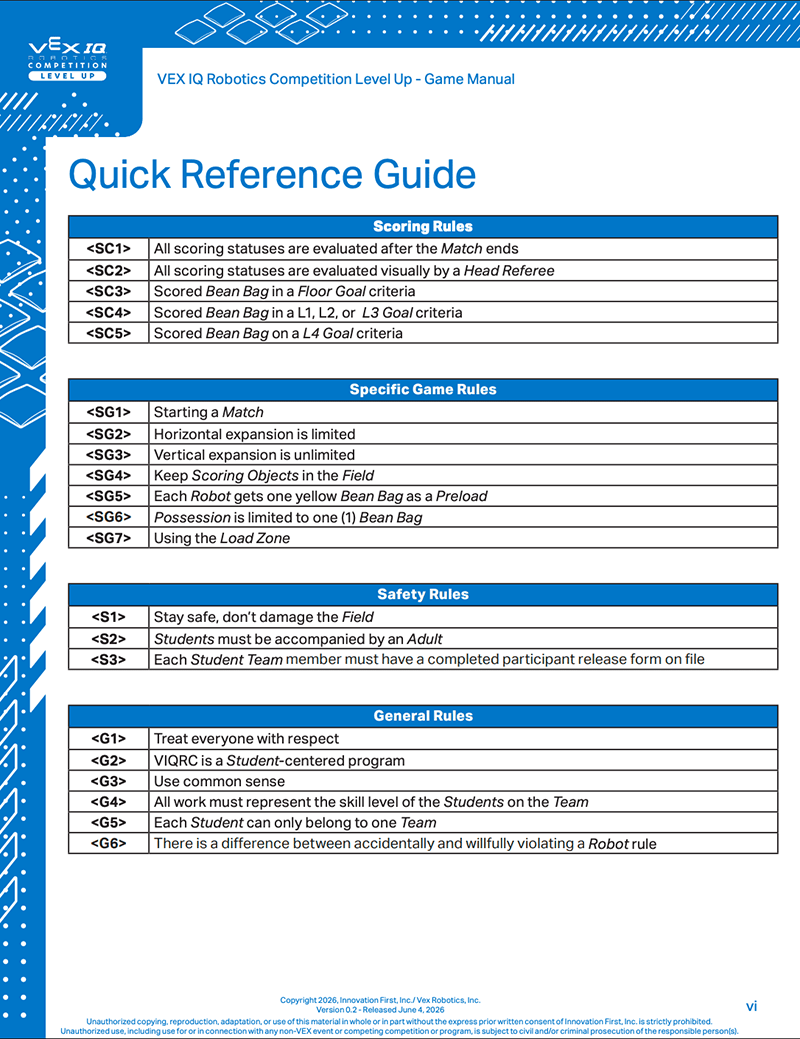
- The Quick Reference Guide. Every rule in the manual is listed here as a one-line summary with its rule number. Think of it as the index to the whole game. Skim it once and you'll have a mental map of where everything lives.
- The Primer and Field Overview (Section 2). A page or two that tells you what the game actually is, the objective, the field, the scoring objects, in quick, easy-to-read language.
VEX IQ coaches get one more on-ramp: the IQ manual includes Appendix B – Simplified Edition, a student-friendly, print-ready summary written by the Game Design Committee for exactly this purpose. It covers how to play, how to score, and the core rules in plain language. It also openly tells students to graduate to the full manual once they're comfortable.
Read just those pieces and your team knows enough to build, code, and play. That's the entire point.
Learn the System, Then Look Up the Details
Once you're playing, the manual becomes a lookup tool. A few habits make that fast:
- Use the rule numbers. Rules are labeled by category:
- <SC> for Scoring — These include how to score the game and any specific criteria for something to count as ‘scored.’
- <SG> for Specific Game rules — These include rules related to the specific game elements and dynamics in this season’s game.
- <GG> for General Game rules — These include game-related rules that are common from season to season, like “robots must be ready to play.”
- <G> for General rules — These include rules related to being a kind and respectful competitor and using common sense. These also are common from season to season.
- <R> for Robot rules — These include rules about criteria and constraints for robot materials and construction.
- <T> for Tournament rules — These include rules about items like the structure of a tournament, Head Referee qualifications, and field specifics.
That way, when a question comes up about possession, you're looking for an <SG> rule, not re-reading 50+ pages.
- Search the PDF. Ctrl-F (or Cmd-F) for a keyword like "Load Zone" or "expansion" will land you on the exact rule in seconds. This is the single biggest time-saver I can offer, and one I use often.
- Read the colored boxes. Those shaded boxes (blue in the VEX IQ manual, red in the VEX V5 manual) are clarifications and examples from the Game Design Committee. They exist to explain a rule in a little bit of a different way when we thought it might help. These are supplements, not separate rules, but they're often the fastest way to understand a rule.
- Trust the Glossary. Capitalized terms have precise, game-specific definitions (words like Possession and Plowing). When a rule confuses you, a defined term is often the missing piece.
- Day 1: Watch the game reveal video and skim the Quick Reference Guide. (VEX IQ teams: read Appendix B together.)
- Day 2: Read the Scoring section (<SC> rules) and look at the field diagrams. Now you know how to play a match.
- Day 3 and beyond: Start building and driving. Look up rules as real questions surface – and they will naturally surface through play.
A Realistic First Week
Here's the workflow I'd hand a brand-new team:
Notice what's missing: a requirement to read every single page of the manual before doing anything. The understanding comes through use, not through a single heroic reading session. This same concept is demonstrated in the Competition 101 STEM Labs as well.
One Important Caveat
Treating the manual as a reference doesn't mean ignoring it. Before your first event, someone on the team (usually the coach) needs to have read the full manual. Students should keep working toward a complete understanding over the season. The manual itself says it best: it's "critical that the entire manual is read and understood, not just parts." A reference-first approach isn't a shortcut around that goal; it's the on-ramp that makes getting there far less overwhelming. And remember, the manual updates throughout the season, so checking back is part of the process, not a sign you did something wrong the first time.

The Takeaway
The size of a Game Manual is a feature, not a barrier. It's the thorough, authoritative answer key for an entire season of questions—and like any good reference, it rewards looking things up rather than reading straight through. Start your team with the Quick Reference Guide and Primer (and the Simplified Edition, if you're in VEX IQ), teach them to use the rule numbers and the search bar, and let real gameplay drive what they read next. You'll spend less time intimidated by the manual and more time doing the thing that actually builds understanding: playing the game.
How does your team tackle a new Game Manual? Share your strategies in the VEX PD+ Community—and if you'd like to build a manual-reading routine that works for your team, schedule a 1-on-1 Session with a VEX expert.