


Designing For Belonging: Lessons from a Community Club
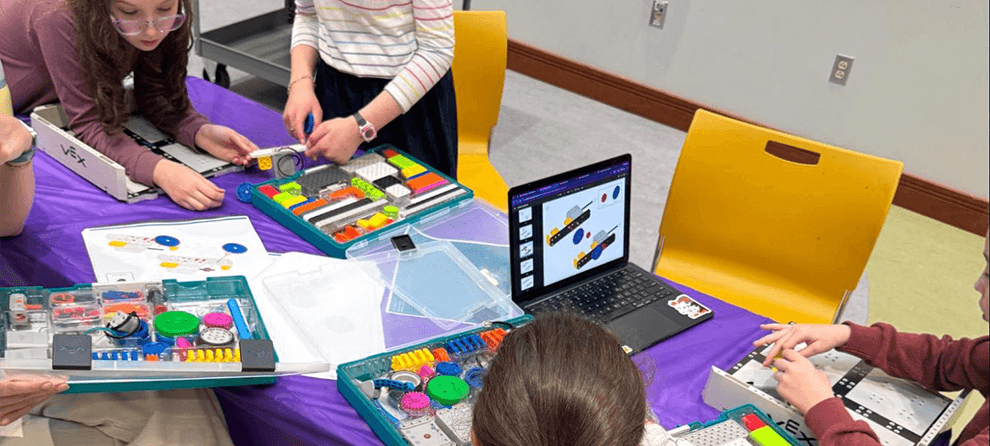
People who know me know how much I love talking about my stepchildren and their involvement in robotics. Watching them explore, build, and iterate is one of my favorite things. When my 12-year-old, Aviva, began planning her Bat Mitzvah service project, she wanted to create something meaningful through a community we know and love. Together, we worked with The Friendship Circle of Pittsburgh to plan and run a short-term robotics club using VEX GO.

© 2026 Friendship Circle (FC)
The Friendship Circle was established to build a more inclusive community by creating opportunities for youth and young adults of all abilities to connect through relationships, shared experiences, and meaningful programs. As a parent of a Friendship Circle member and an educator, this project felt especially personal. It was a chance not only to give back, but to create a space where friends could come together, build, and learn in ways that worked for them.
Over three weeks, students gathered to explore robotics—building, testing, asking questions, and collaborating with one another. What stood out to me most wasn’t just what they built, but how they participated. Each session became a reminder that robotics can be more than a tool for teaching STEM concepts. When thoughtfully structured, it can also be a powerful way to support connection, confidence, and inclusion.
The three, 75-minute sessions followed this progression:
- Learn about the kit and begin free-building with the Animal Rescue Activity Series.
- Follow their first set of build instructions after choosing a VEX GO Creature.
- Modify their VEX GO Creature to make it faster, move more smoothly, or give it a personality, then share their modifications through a group presentation.
Robotics as a Tool for Connection

From the very first session, it was clear that this experience was about more than just building robots. As friends gathered around their kits, conversations emerged naturally. Instead of needing prompts or structured discussion, students began talking through what they were doing, asking each other questions, and reacting to what they saw. In many classrooms, students chatting with one another may seem like an obvious occurrence. But for neurodiverse students, there can be anxiety around what to say, when to say it, and who to talk to.
There is something uniquely effective about robotics as a shared experience. Students aren’t just listening to a speaker or watching a movie; they’re doing something together. That shared focus and goal creates an environment where communication feels more natural and less pressured. For many of the students in this club (including my own child on the Autism spectrum), that mattered. The building became a common ground that could grow into collaboration.
Over the course of the three sessions, I saw students begin to rely on one another in small but meaningful ways. They checked in with their partners, celebrated when something worked, and stayed engaged even when a build didn’t go as planned. These weren’t always loud or obvious moments, but they were important. They showed that the learning happening in the room wasn’t just about robotics—it was about connection.
Tess Roth, the Programs Manager for Under 18, shared that this was some of the highest, most consistent engagement she had seen in a club in a long time. She noted that students were not only engaging with each other, but with the materials themselves.

What Made It Work: Designing for Inclusion
As I reflected on the success of these sessions after talking with Tess, I realized that the engagement we saw wasn’t accidental. Instead, it was supported by thoughtful design of both the tools we used and the way the experience was structured.
Tools That Lower Barriers
One moment that stood out came from the Friendship Circle staff member supporting the program. As students worked through their builds, she paused and said something that stuck with me: she was amazed at how accessible the VEX GO system was—especially something as simple as the Pin Tool.
Throughout the sessions, students reached for the Pin Tool constantly. They used it to remove pins, insert pieces, adjust builds, and make changes independently. What might seem like a small design feature became incredibly important. It reduced frustration, gave students more control over their builds, and allowed them to participate without always needing assistance.
That independence matters. When students can manipulate materials on their own, they are more likely to stay engaged, take risks, and feel ownership over their work. In this case, the physical design of the tools directly supported inclusion. VEX GO’s design, especially features like the Pin Tool and color-coded construction system, played a key role in making this possible.


Beyond the Pin Tool, students’ experiences building was tailored to their needs based on the type of build instruction they used. While one group used the digital build instructions to easily keep track of their build progress and the orientation of pieces, others were better suited to use a printed format. Printed PDF instructions allowed those groups to focus on the build at hand rather than fall into screen-based distractions.
My Classroom Takeaways:
- Choose tools and materials that lower barriers to entry. Small design elements like ease of use, accessibility, and flexibility can have a big impact on how confidently students participate.
- Be flexible in how students interact with materials. Not all groups need to interact with materials in the same way.
Structure that Supports Participation
Another key element was the use of clearly defined roles within each group. While the friends worked in small teams, there was a set of responsibilities for each person.
What stood out to me was how each group embraced their roles. They followed the structure, supported one another, and transitioned between roles as the build progressed. Instead of creating limitations, the roles provided clarity. Students knew how they could contribute, which made participation more accessible and less overwhelming.
While some groups used a timer to rotate roles, others chose roles and stayed with them throughout the build. There was no single “right” way to structure participation, and that flexibility was part of what made the experience successful.

In our second session, a girl was running around the table during building. Not because of disrespect or lack of care, but because she had been managing her ADHD all day and needed movement to regulate. Instead of being scolded or sitting still to build, she did small laps around the table while her partner built, then would be asked by her partner to gather parts. After meticulously gathering building materials from the kit, she would be off again. Still listening to her partner, still engaging with the building process, but doing it in a way that best met her needs at that moment. The flexibility of structure for groups like this also lent itself to making this more accessible and friendly for children of all abilities.
My Classroom Takeaways:
- Assign clear, purposeful roles within group work.
- Rotate roles so all students can experience different aspects of the task.
- Use structure as a way to support participation and be flexible with that structure to best meet your students’ needs.
Let Curiosity Drive Creativity
One of the most exciting things to watch over the three weeks was how naturally curiosity emerged—and how quickly it turned into creativity. Students weren’t just following instructions; they were constantly asking questions.
- “When are we going to add wheels?”
- “Why are Flopper’s legs so long?”
- “Can I make my robot faster?”
These questions led to exploration. Students would test ideas, make adjustments, and sometimes take their builds in entirely new directions. That sense of ownership—of wondering, trying, and discovering—was present in every session.
What stood out most was that this curiosity didn’t need to be forced or prompted. It grew out of an environment where students felt comfortable engaging with the materials and with each other. Because they had accessible tools and clear guidance, they had the confidence to explore beyond the basic instructions.
That exploration often led to creative outcomes like small modifications to builds, new ideas for how to use a piece, or even just a deeper understanding of how things worked. The learning wasn’t linear, and that was part of what made it meaningful.

My Classroom Takeaways:
- Leave space for exploration within structured activities.
- Encourage “what if” questions and treat them as part of the learning process.
- Recognize that creativity often comes from giving students time and permission to investigate.
What Students Gained: Confidence, Connection, and Ownership
As the weeks went on, the impact of the club became more and more visible not just in what students were building, but in how they were engaging with one another and with the learning process. These changes showed up in three key ways.

Students began to show greater confidence in their abilities. Tasks that may have felt uncertain at the beginning like connecting pieces, following build instructions, or contributing ideas became more familiar. That confidence often showed up in small ways: reaching for a piece without hesitation, offering a suggestion to a teammate, or trying again after something didn’t work the first time.
There was also a clear sense of connection developing within and between the groups. Because students were working toward a shared goal, they had a reason to communicate and collaborate. This extended beyond singular groups and led to conversations between groups as students shared what worked for them. The group that had previously asked about Flopper’s legs were able to share their observations and results of their experiments with another group who was starting to struggle with the same modifications.
Students then continued to ask for help, offer support, and celebrate progress together. These moments may have been subtle, but they were meaningful. They reflected the kind of social learning that is at the heart of both robotics and the mission of the Friendship Circle.
Perhaps most importantly, students developed a sense of ownership over their work. They were building something that was theirs rather than completing a task. They made decisions, tested ideas, and saw the direct results of their efforts. That ownership helped keep them engaged and invested throughout each session. As the final activity, each group shared their final build including anything they changed, why it was changed that way, and how successful those changes were.
These group presentations gave students an opportunity to explain their questions and thought process, share their group collaborations, and celebrate the failures they had throughout the sessions.
Together, these experiences highlight something important: when students are given the opportunity to participate in ways that are accessible and meaningful to them, they don’t just learn—they thrive.

Final Reflections
This experience was a powerful reminder that robotics can be more than a way to teach STEM concepts. It can be a tool for building connection, confidence, and a sense of belonging.
The success of this club didn’t come from simplifying the learning. It came from designing the experience so that students could access it in ways that worked for them. When we do that, we open the door for more students to participate, contribute, and see themselves as capable learners.
Whether you’re running a classroom lesson, an after-school club, or a community program, small design choices can have a big impact. By focusing on accessibility, structure, and opportunities for connection, we can create learning environments where every student has a place.
While this club was based around the Animal Rescue Activity Series and Creature Feature Activity Series, these strategies and philosophies shared here apply to any robotics implementation.
If you’ve tried similar strategies in your classroom, share your experiences in the PD+ Community! And if you’re looking for ways to bring inclusive robotics experiences to your students, schedule a 1-on-1 Session—we’d love to support you.