


The Power of Camps and Non-Formal Education

There is no question quite as important as “why” when students start to talk. They are questioning the world around them, whether that be the rules of a game or the cause behind baking soda and vinegar making a chemical reaction. That inquiry and excitement around investigating new ideas is something that can be fostered well in non-formal education. Outside the confines of a traditional school day with tests, standards, and rigid schedules, students can bring their ideas to life and have time to question the things around them. Camp is a fantastic way to foster that inquisitive nature, and help students grow and learn in their own fashion.
Aimee DeFoe wrote an article a few months ago all about the importance of play and learning for students of all ages, especially around STEM topics. If you want to learn more about that connection, read The False Dichotomy Between Play and Learning article. My goal in this article is to communicate how to apply that knowledge and understanding of the importance of play into non-formal education spaces.
It is also important to distinguish the idea of the informal learning children do as they play at home or on a playground with the non-formal learning that can come from camps, museums, after-school clubs, or other more organized ventures.
Non-formal learning and education can be described as supportive and prearranged, and that students’ “motivation may be extrinsic but it is typically more intrinsic,” which is important to think about when talking about camp and the value that camp can bring to students through play.1
By breaking education and learning out of the molds that schools offer, students have a chance to explore through structured play. Structured play can be seen in goal-oriented activities as an adult facilitator provides that end goal, but students can explore whatever path they are interested in to meet that goal. In order for students to be the ‘drivers’ on the learning pathways that camp and non-formal education can offer, there needs to be flexibility to allow for attentiveness, creativity, and collaboration to flourish. That’s a lot of theoretical information about the benefits of non-formal learning in the space of camps. When I was teaching camps and classes at a museum, I saw this in different instances, but one specific instance of motivation and flexibility comes to mind.
The name of the summer camp was “Apocalyptic Architecture” and was aimed at 10 and 11 year old campers. During the camp, we ran simulation cities where each group had to develop their city as city planners and then we had random apocalypses that would occur. They had to use the city plans they came up with and their teamwork to respond to each of these disaster scenarios. One of the randomized disasters was a hurricane that took out anything within five grid squares of water. Without fail, every single city in the classroom was destroyed and the campers were noticeably distraught. While they had taken some interest in the other disasters we had discussed including tornadoes, tsunamis, or even other catastrophic flooding due to rainfall alone, the hurricane made an immediate impact and impression.

Based on their emotional response and interest, we spent the rest of the day researching hurricanes. What caused them and their impacts on various communities. After understanding some of the science behind a hurricane, they asked about Hurricane Katrina that devastated New Orleans in 2005. Most of these students had not even been born, but they watched videos about the levees breaking and the aftermath of the city planning and engineering missteps. If this had happened in a traditional classroom, we probably would never have been doing city planning for a week straight to begin with. But they had questions and interest, and I was able to redirect that anger and frustration from their pretend cities being destroyed into a science lesson, a civics lesson, and a general social-emotional lesson as well. The sympathetic response from 10 and 11 year old campers was something I had not seen at that level before.
Keeping a rigid schedule helps no one during these camps. There were some activities that we did not get to, but I got to share with parents some of the reflections that these students had after the “levees” broke in our simulated cities. Many of them talked to their campers about hurricanes that night and the students came back the next day with more facts and more questions to share. The freedom and curiosity of the campers, however, can only be honored when camp staff is flexible.
When planning a camp, there are many things to take into consideration, from hiring and training staff, renting space, gathering materials, finding registrations, and actually running an exciting and safe camp. If you have never run a camp before, I encourage you to use this How To Plan template to begin the step by step process of starting your camp. This, and the other resources I will reference, are all available at camps.vex.com under the In Person or Virtual Resources section for each camp. As a first time camp planner, first, welcome! It can be a stressful time, but the difference you can make for campers is well worth it. These resources can help remove some of that stress as well.
Building camp staff’s capacity for flexibility comes from two main places: the nature of the camp schedule, and the nature of the staff member(s) themselves. If the schedule itself is rigid and unforgiving, then campers may be reminded of the rigors of school and the engagement could be lost. If the staff members are unwilling to deviate from a suggested schedule, or are unsure how to facilitate camp, then the experience of campers will also suffer. Let’s take each of these scenarios one at a time.
Creating a schedule that allows for flexibility
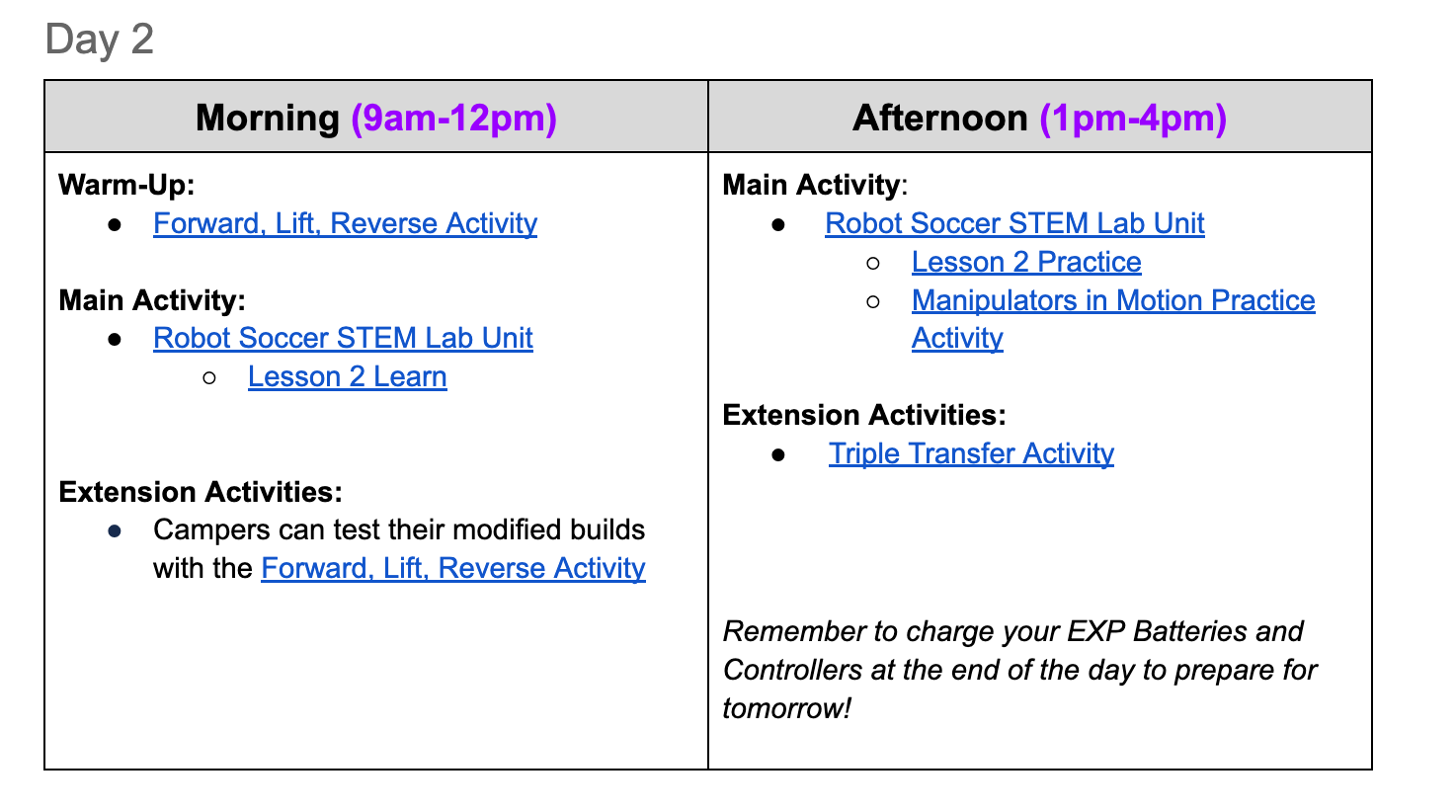
The schedules available at camps.vex.com are intended to support a flexible implementation. For GO, IQ, EXP, and V5 camps, there are lists of morning activities and afternoon activities with some possible extensions for each. If students are excited about a specific classroom competition or investigation, then you should encourage them to continue that exploration! If they are not as interested in a particular activity, try to pique their interest with an extension, or move on to another activity entirely.
VEX 123 Camps are designed to meet young students where they are, taking things like shorter attention span and developing social skills into account. As such, camp schedules provide for a half day implementation, with activities broken down further, with additional 'brain breaks' included. This can allow camp staff to support campers to explore activities, while allowing them to be themselves. There are enough activities so that camp staff can shorten or lengthen engagements to follow the interests and attentiveness of the students on any given day.
Promoting Flexibility within your camp staff
There are manual templates provided for both In Person and Virtual camps. These documents are intentionally comprehensive, to help take the guesswork out of camp staff training, and give guidance on how to best promote the values of non-formal education. The manual goes through a few major categories:
- Staff expectations
- Safety considerations
- Camp procedures
- Facilitating camp
When looking to make your camp staff comfortable with both campers and the VEX robots they will work with, I highly recommend focusing on the facilitating camp section. Guidance is provided for using VEX, facilitating coding and engineering conversations, and strategies for promoting positive social skills in camps. Because young campers require some different strategies, a VEX 123-specific camp manual is provided for use with 123 camps.
The role and importance of non-formal education in inspiring lifelong learners cannot be underestimated. I have seen students and adults alike learn and grow through these open-ended explorations and they have been some of the most eye-opening educational experiences of my career. VEX Camps are a great resource for a number of practical and tangible reasons (like fundraising for your team, supporting parents when their students are out of school, etc.). However, the intangible reasons like inspiring curiosity, fostering a lifelong love of learning, encouraging creativity and collaboration, and opening doors to future pathways that students may not have known existed are just as meaningful, if not moreso. All it takes is a bit of flexibility and some excitement, and I know you can make your own special camp memories as well!
Alaina Caulkett is a Senior Education Developer at VEX Robotics.
Like this article? Discuss it in the VEX Professional Learning Community.